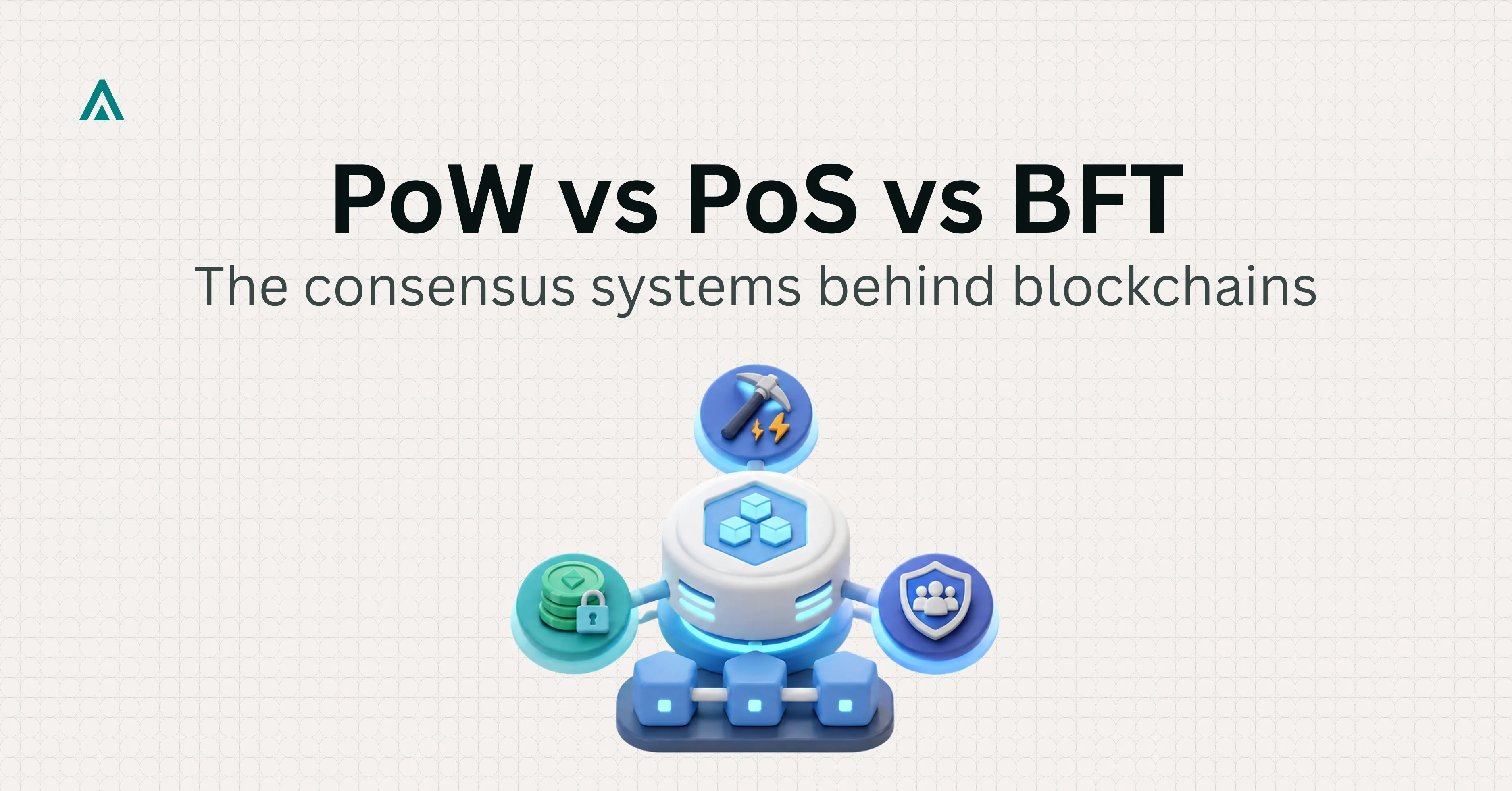
Blockchain Consensus Mechanisms: PoW vs PoS vs BFT
Table of Contents
Table of Contents
Share
Bitcoin hit 1,067 EH/s in June 2025. Compare PoW, PoS, DPoS, and BFT consensus: finality, throughput, energy. Build the right infrastructure for your use case.
Frequently Asked Questions
- A consensus mechanism is the protocol by which all nodes in a distributed blockchain network agree on the current state of the ledger without trusting any single party. It replaces the role of a central authority. The four primary models are Proof of Work (PoW), Proof of Stake (PoS), Delegated Proof of Stake (DPoS), and Byzantine Fault Tolerant (BFT) consensus.
- Proof of Work requires miners to expend computational energy solving hash puzzles, with the winner earning block rewards. Proof of Stake requires validators to lock up tokens as collateral instead of burning energy. Ethereum's switch from PoW to PoS in September 2022 (the Merge) reduced its energy consumption by nearly two orders of magnitude compared to its prior PoW operation, as documented by ethereum.org.
- Byzantine Fault Tolerance refers to a system's ability to reach consensus even when some nodes behave maliciously or unpredictably. Blockchain BFT implementations like Tendermint can tolerate up to one-third of validators acting faulty or malicious while still finalizing blocks. BFT provides instant finality, typically within 1-7 seconds, unlike PoW's probabilistic finality.
- DPoS is a consensus variant where token holders vote to elect a fixed set of delegates who produce blocks on their behalf. EOS uses 21 elected block producers; TRON uses 27 Super Representatives elected every six hours. DPoS trades decentralization for speed, with EOS targeting 4,000+ TPS and TRON processing approximately 2,000 TPS.
- Enterprise blockchains almost universally choose BFT-based consensus (PBFT, Tendermint, HotStuff, or IBFT) because it provides instant finality, known validator sets, and no mining overhead. Hyperledger Fabric uses a pluggable ordering service with BFT options. Public-facing enterprise applications often use PoS networks like Ethereum for their security and ecosystem maturity.
Don't Miss What's Next
Subscribe to newsletter
Tags:
blockchain consensus mechanisms
proof of work
proof of stake
Byzantine fault tolerance
consensus
Web3 Infrastructure
2025
Blockchain
Get in Touch
Our team will get back to you within 24 hours.