Data Labeling Framework for Enterprises in 2026
Table of Contents
Table of Contents
Share
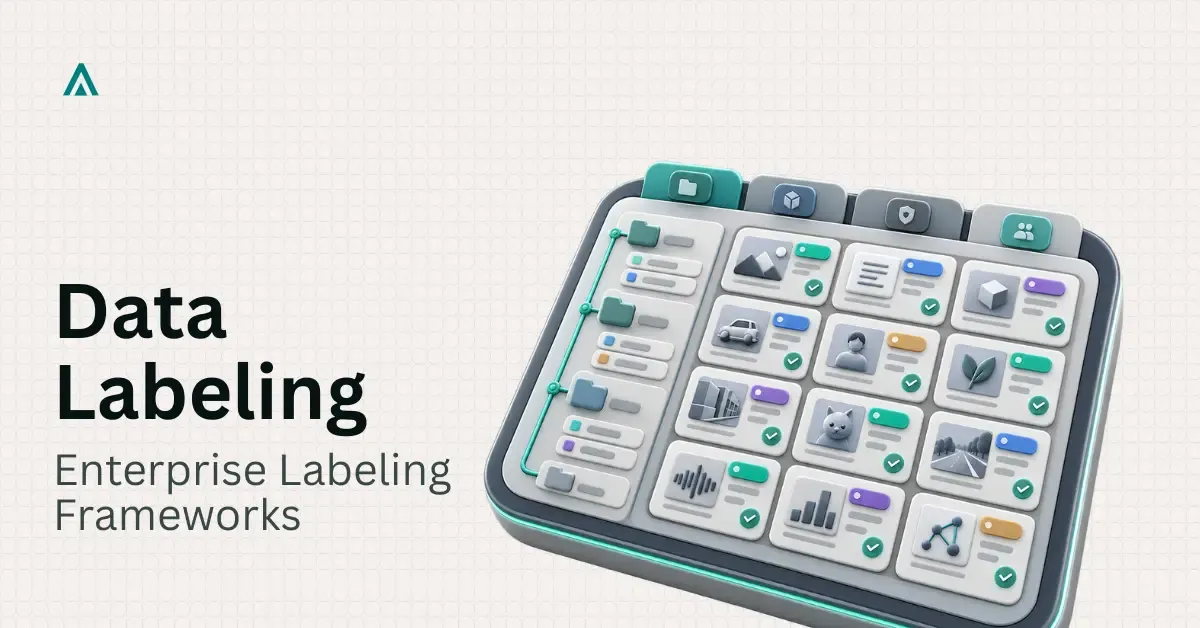
Data labeling framework: benchmark test sets average at least 3.3% label errors, and the EU AI Act names labelling. What enterprises should require in 2026.
Frequently Asked Questions
- It sets who labels data, to what written standard and how each batch is accepted, through three parts (a label guide, a workforce model and a gold-set quality loop with an agreement threshold), with a provenance tag on every label. Public benchmarks show why the gold set matters: on average across 10 common datasets, at least 3.3 test labels in every 100 are wrong (Northcutt, Athalye and Mueller, November 2021).
- Yes, for high-risk systems. Article 10 requires governance practices covering annotation, labelling and cleaning of training, validation and testing data, and Annex IV requires technical documentation to describe labelling procedures. Under the Digital Omnibus on AI, these duties apply to Annex III systems from 2 December 2027 (Regulation (EU) 2026/1744, July 2026). Many internal analytics models sit outside Annex III.
- They can draft labels, not certify them. One study found that, in low-budget tests, GPT-3 labels cost between half and one twenty-fifth of human labels for the same downstream performance on the tasks tested (arXiv, August 2021). Human review against a gold set still decides whether a batch is accepted, because unchecked model output can erase rare cases when generative models are repeatedly trained on their own output (Nature, July 2024).
Don't Miss What's Next
Subscribe to newsletter
Tags:
data labeling
training data
AI governance
market intelligence
EU AI Act
Get in Touch
Our team will get back to you within 24 hours.