Prompt Engineering for Enterprises: What It Is, How It Works & Why It Matters
Table of Contents
Table of Contents
Share
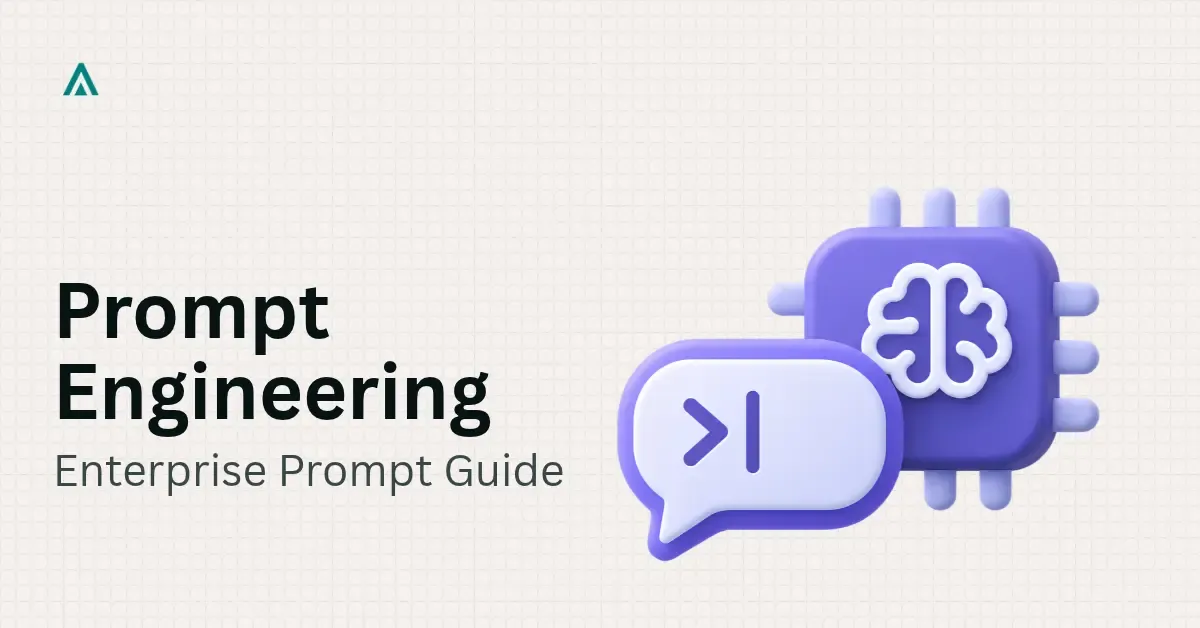
Prompt engineering for enterprises: prompt format alone moved one model's accuracy by up to 76 points (arXiv, 2024). Treat every prompt as a tested release.
Frequently Asked Questions
- It is the discipline of writing, testing and versioning the standing instructions a company sends to a language model with every request: policies, examples, output format and limits. At enterprise scale the prompt needs an owner, a test set that decides whether a change ships, and a cost line, because the instructions are billed on every call.
- Start with prompts and retrieval, and fine-tune only when a measured gap remains. Prompt changes ship in hours and roll back easily; a fine-tuned model needs data, a training run and new evaluation. In one study, formatting changes alone moved a model's few-shot accuracy by up to 76 points (Sclar et al., arXiv, July 2024), so test the prompt properly before paying to retrain.
- No law regulates prompts as such; duties attach to the data and decisions they carry. If a prompt sends EU personal data to a model, GDPR Article 5 requires that data to be limited to what is necessary for the purpose and the controller to be able to demonstrate compliance (gdpr-info.eu, October 2026). NIST's voluntary Generative AI Profile gives a risk-management structure for the rest (NIST AI 600-1, July 2024).
Don't Miss What's Next
Subscribe to newsletter
Tags:
prompt engineering
enterprise AI
prompt caching
LLM evaluation
market intelligence
Get in Touch
Our team will get back to you within 24 hours.