Offshore to Hybrid Staffing: What's Changing for Enterprises in 2026
Table of Contents
Table of Contents
Share
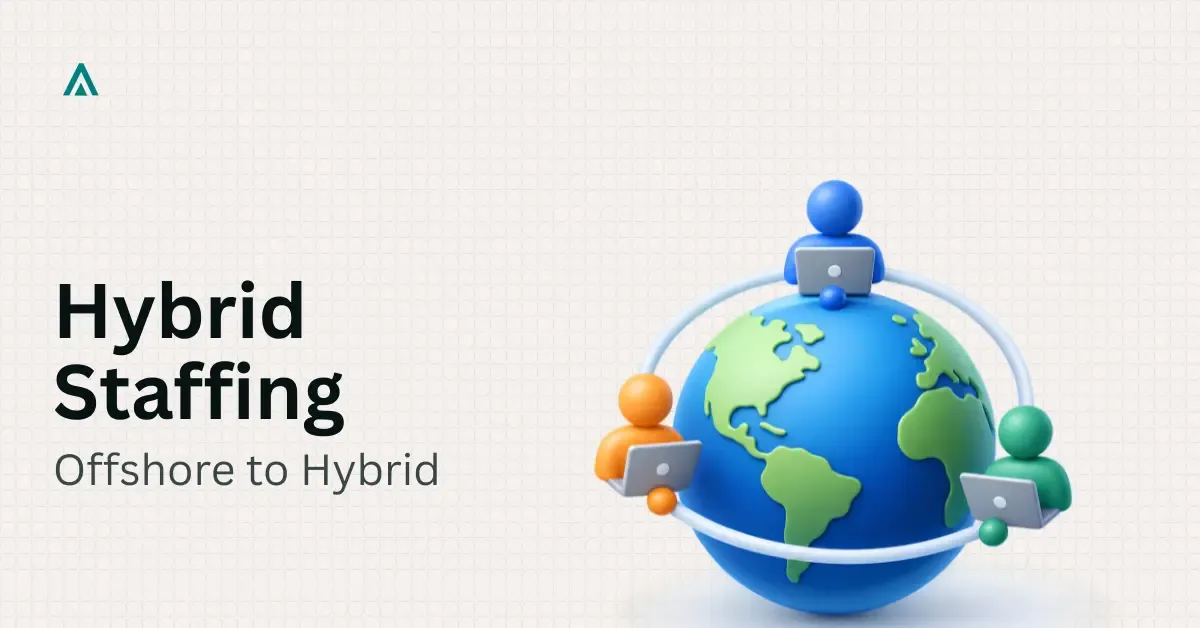
Offshore to hybrid staffing in 2026: review why 9.1% projected India pay rises and GDPR transfer rules decide which roles stay offshore or move onshore.
Frequently Asked Questions
- Hybrid staffing splits one engineering team across an onshore core, owned offshore centres and outside vendors, all working in one backlog. In my view, the split should follow which roles can reach production data and who reviews merged code, not which location bills the lowest hourly rate.
- Often, yes. The EDPB's Guidelines 05/2021 say that a third-country processor remotely accessing EU-stored data, for example for support, results in a transfer under Chapter V of the GDPR (EDPB, February 2023). An employee travelling abroad who opens the company database remotely is not a transfer, because the employee is part of the controller.
- Usually, but the gap is narrowing. EY's Future of Pay 2026 report projects overall salary increments in India of a little over nine percent for 2026, with global capability centres highest (EY, February 2026). By my arithmetic, that pace compounds to more than half again over five years, so I price a five-year contract, not a single invoice.
- Mostly not. Section 17(1)(d) of the Digital Personal Data Protection Act, 2023 disapplies Chapter III, section 16 and Chapter II except sections 8(1) and 8(5) where a person in India processes personal data of people outside India under a contract with a person outside India (Act No. 22 of 2023, August 2023). Neither section is in force yet: a Gazette of India notification of 13 November 2025 brings both into force on 13 May 2027.
Don't Miss What's Next
Subscribe to newsletter
Tags:
Hybrid Staffing
Offshore Delivery
Global Capability Centres
Founder Perspectives
GDPR
EU DORA
Get in Touch
Our team will get back to you within 24 hours.