Quantum-Safe Ethereum: PQC Integration at the Protocol Layer
Table of Contents
Table of Contents
Share
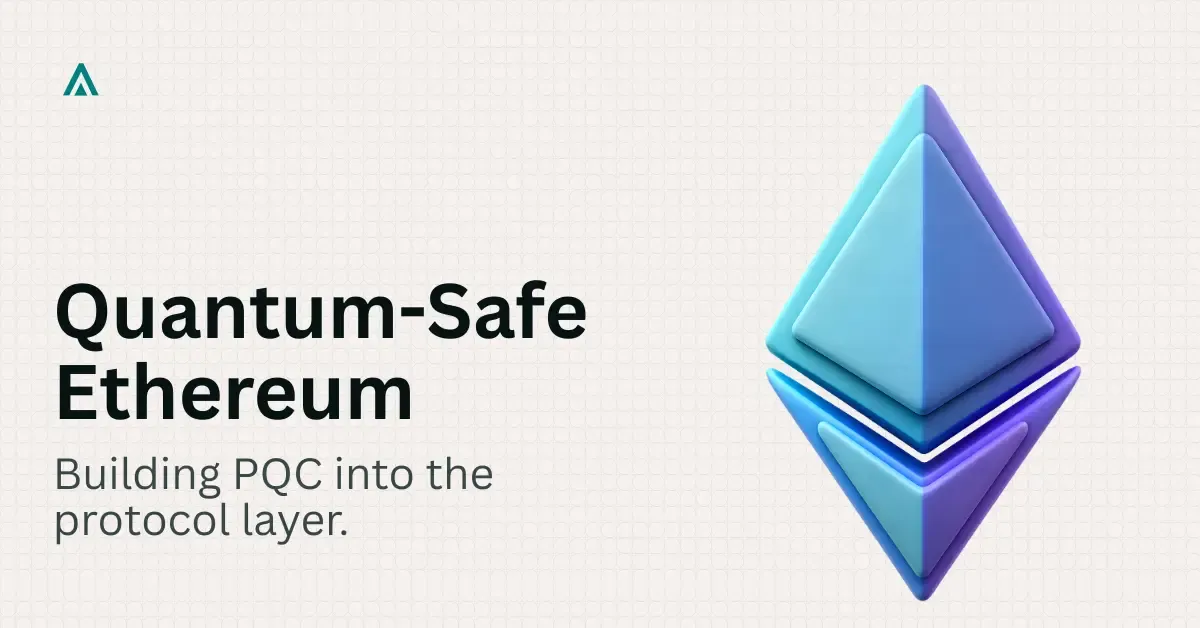
NIST FIPS 203-205 finalized August 2024. Here is Ethereum's protocol-layer roadmap to audit, verify, and migrate ECDSA to post-quantum signatures now.
Frequently Asked Questions
- Post-quantum cryptography for Ethereum refers to signature and key-exchange schemes, primarily lattice-based ML-DSA and hash-based SLH-DSA, standardized by NIST FIPS 204 and FIPS 205 in August 2024, that remain secure against attacks run on a cryptographically relevant quantum computer. Ethereum's current transaction signing (ECDSA on secp256k1) and validator aggregation (BLS12-381) both rely on elliptic curve discrete-log hardness, a problem Shor's algorithm solves in polynomial time on a sufficiently large fault-tolerant quantum machine.
- Elliptic curve cryptography depends on the discrete logarithm problem, which Shor's algorithm breaks efficiently on a quantum computer. Post-quantum schemes rely on different hard problems, lattice-based Module-LWE for ML-DSA and hash-collision resistance for SLH-DSA, that remain intractable even with quantum speedups such as Grover's algorithm, which only halves effective key strength rather than breaking the scheme outright.
- Protocol teams building account-abstraction wallets, custodians holding long-dormant exposed public keys, and enterprises with multi-year smart contract deployment horizons should begin migration planning now. Ethereum's account abstraction stack lets these teams adopt post-quantum signature verification at the application layer years before any base-layer consensus change is required.
Don't Miss What's Next
Subscribe to newsletter
Tags:
Post-Quantum Cryptography
Ethereum
Protocol Security
ML-DSA
Account Abstraction
Cryptography
Get in Touch
Our team will get back to you within 24 hours.