FATF Travel Rule 2026: Virtual Asset Enforcement Guide
Table of Contents
Table of Contents
Share
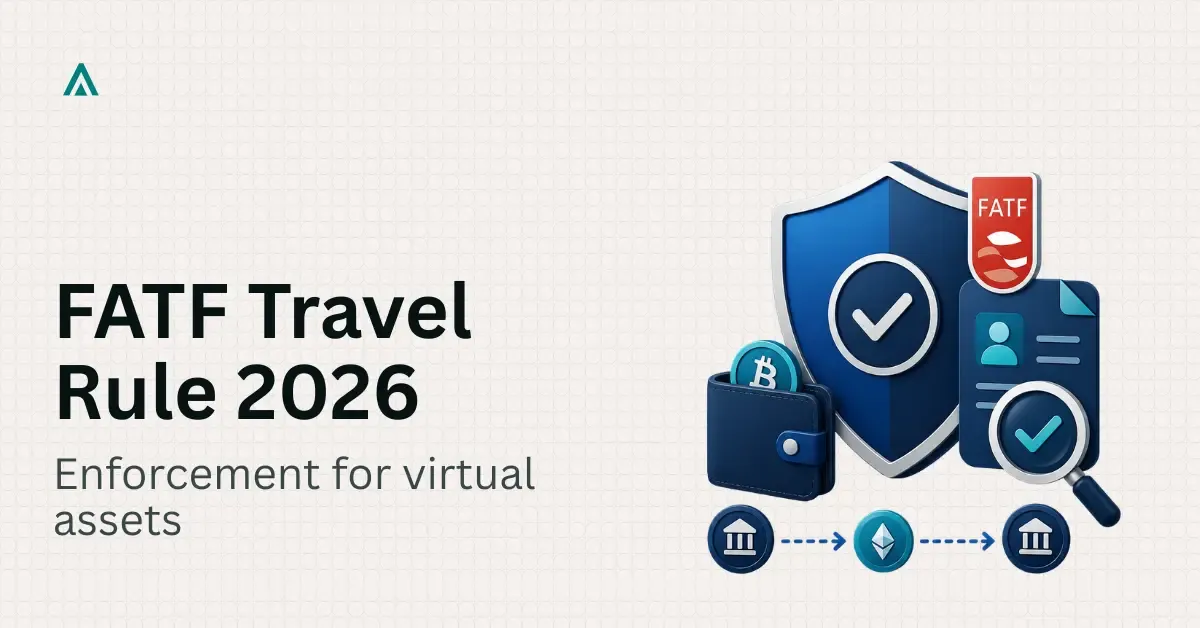
FATF Travel Rule enforcement in 2026: 85 jurisdictions legislate it, but only 41% issued supervisory findings. Audit your VASP compliance architecture now.
Frequently Asked Questions
- The FATF Travel Rule is Recommendation 16, extended to virtual assets in 2019, requiring VASPs to collect and transmit originator and beneficiary information alongside crypto transfers above a jurisdictional threshold, mirroring the data that already accompanies traditional wire transfers.
- Bank wires route through SWIFT with a single message standard and decades of correspondent banking relationships. Crypto transfers move across dozens of competing messaging protocols, wallet types that cannot always identify a counterparty VASP, and a materially higher share of self-hosted wallets that fall outside the rule's data-sharing chain entirely.
- Enterprise innovation leads, compliance officers, and CTOs at licensed exchanges, custodians, and payment institutions handling virtual asset transfers are the primary audience, since they carry direct regulatory liability for originator and beneficiary data collection, transmission, and screening.
- Supervisors expect VASPs to apply a risk-based response, ranging from enhanced due diligence and holding the transfer for manual review, to declining the transaction outright when the counterparty cannot be verified or the receiving jurisdiction has not implemented equivalent standards.
Don't Miss What's Next
Subscribe to newsletter
Tags:
FATF Travel Rule
Virtual Asset Compliance
AML
VASP
Web3 Development
Get in Touch
Our team will get back to you within 24 hours.