What Is a DAO? Governance and Smart Contract Guide
Table of Contents
Table of Contents
Share
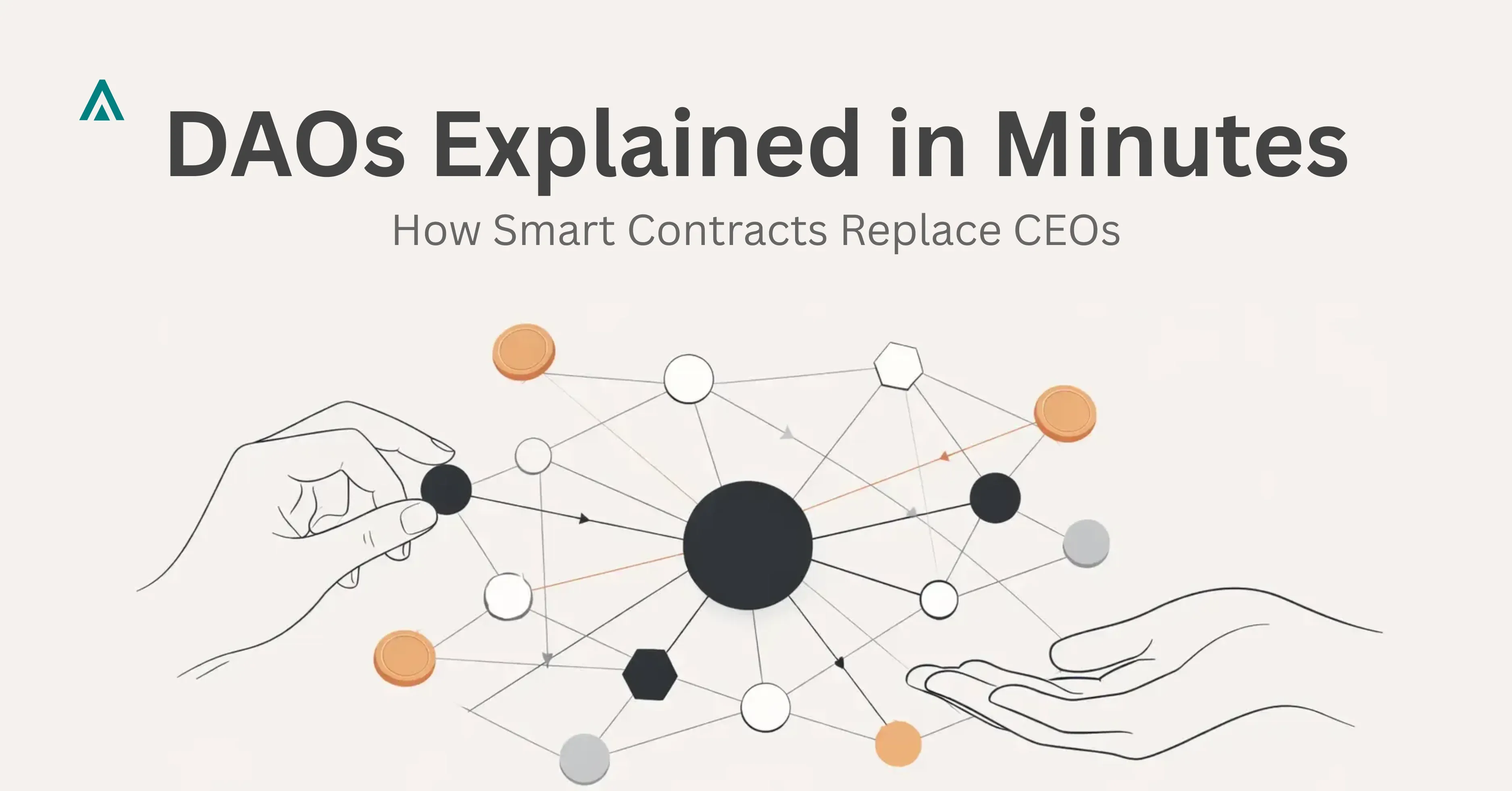
Over 13,000 DAOs manage $21B+ in on-chain treasuries. Audit-ready guide to DAO governance structures, voting mechanics, and the smart contracts powering them.
Frequently Asked Questions
- A DAO (Decentralized Autonomous Organization) is an organization whose rules are encoded in smart contracts on a blockchain. Members vote using governance tokens to decide how the protocol operates, how treasury funds are spent, and what parameters to change, without any central authority.
- Members submit proposals on-chain. After a voting delay, token holders (or their delegates) cast votes during a defined voting period. If the proposal meets quorum and passes, it enters a timelock queue before execution, giving the community time to exit if they disagree with the outcome.
- Most DAOs use three core contracts: a Governor contract (handles proposal lifecycle and vote counting), a `TimelockController` (delays execution), and an ERC-20 Votes token (tracks governance weight). OpenZeppelin's Governor framework is the industry standard for this architecture.
- Yes. Beanstalk Farms lost over one hundred eighty million dollars in April 2022 when an attacker used a flash loan to acquire a governance supermajority in a single transaction, passed a malicious proposal, and drained the treasury. Timelocks and quorum safeguards are the primary defenses against this attack vector.
- Off-chain governance (e.g., Snapshot) records votes on IPFS but execution requires a trusted multisig to act on results, introducing a trust assumption. On-chain governance executes proposals directly via smart contracts with no intermediary. Most production DAOs use a hybrid: Snapshot for sentiment polling, on-chain for binding decisions.
Don't Miss What's Next
Subscribe to newsletter
Tags:
what is DAO
DAO governance
DAO smart contracts
Identity & Governance
2025
Web3 Development
Get in Touch
Our team will get back to you within 24 hours.