Kubernetes for Enterprises: What It Is, How It Works & Why It Matters in 2026
Table of Contents
Table of Contents
Share
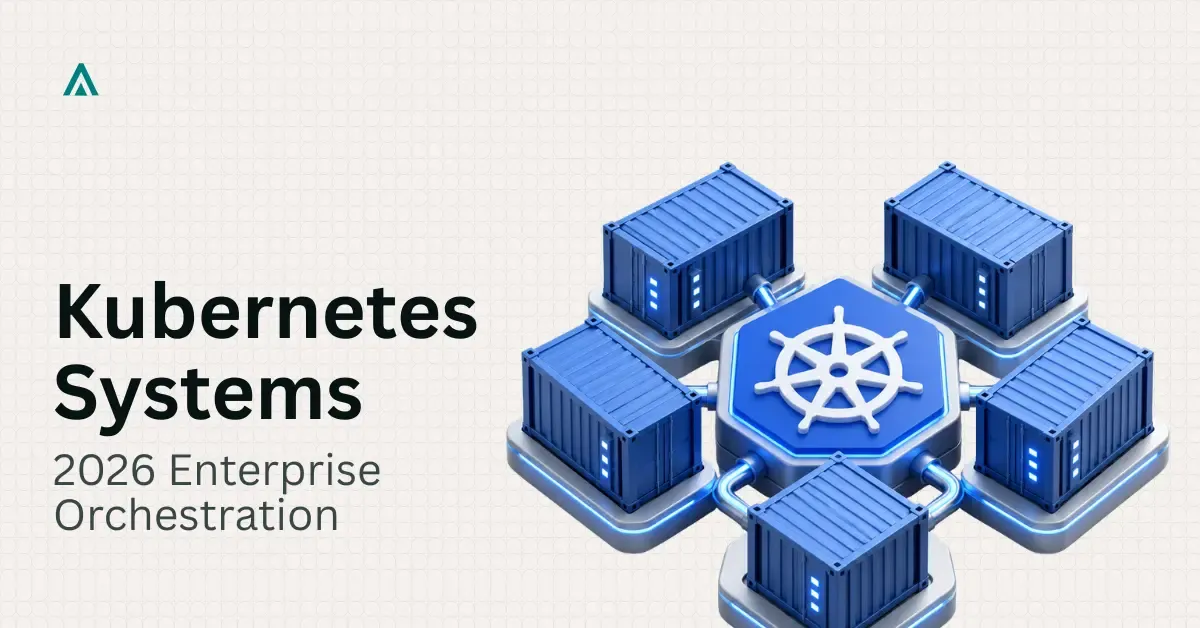
Kubernetes for enterprises in 2026: 82% of container users run it in production. See how it works, what upgrades cost, and how to assess whether you need it.
Frequently Asked Questions
- Kubernetes is open-source software that runs containerised applications across a group of machines and keeps them in the state you declare. It places each container on a machine with room for it, restarts copies that fail, spreads traffic across healthy copies and rolls out new versions gradually. Google open sourced it in 2014, and an enterprise adopting it takes on the surrounding work as well: identity, network rules, backups, cost allocation and a version calendar that someone has to own.
- Usually, once engineer time is counted. Amazon EKS lists its control plane at ten cents per cluster per hour under standard version support (Amazon EKS pricing, October 2026), which is small next to the salary cost of patching, upgrading and running on-call for a self-built control plane. The fee rises to sixty cents per cluster per hour once a version moves into extended support, so a managed cluster stays cheap only while you keep it current.
- Yes for production, and for most companies one production cluster plus one non-production cluster is the right opening shape. Every extra cluster adds another control-plane fee and another upgrade to rehearse each cycle. Start with a single production cluster that holds the services with different scaling needs, keep a smaller non-production twin for rehearsing upgrades, and split further only when a regulatory, regional or failure-isolation boundary requires it.
- The version stops receiving upstream fixes after roughly fourteen months (Kubernetes patch releases, October 2026), and managed providers then act on their own terms. On Amazon EKS the cluster moves to extended support by default at six times the standard hourly fee and is eventually auto-upgraded without rollback. On Azure Kubernetes Service, from June 2027 clusters left on an unsupported version are upgraded automatically after a 60-day grace period, regardless of your maintenance window (Microsoft Learn, 2026).
Don't Miss What's Next
Subscribe to newsletter
Tags:
Kubernetes
platform engineering
managed Kubernetes
ICP-2
Get in Touch
Our team will get back to you within 24 hours.