Arbitrum Freezes $71M in Stolen Kelp DAO ETH: L2 Trust Reset
Table of Contents
Table of Contents
Share
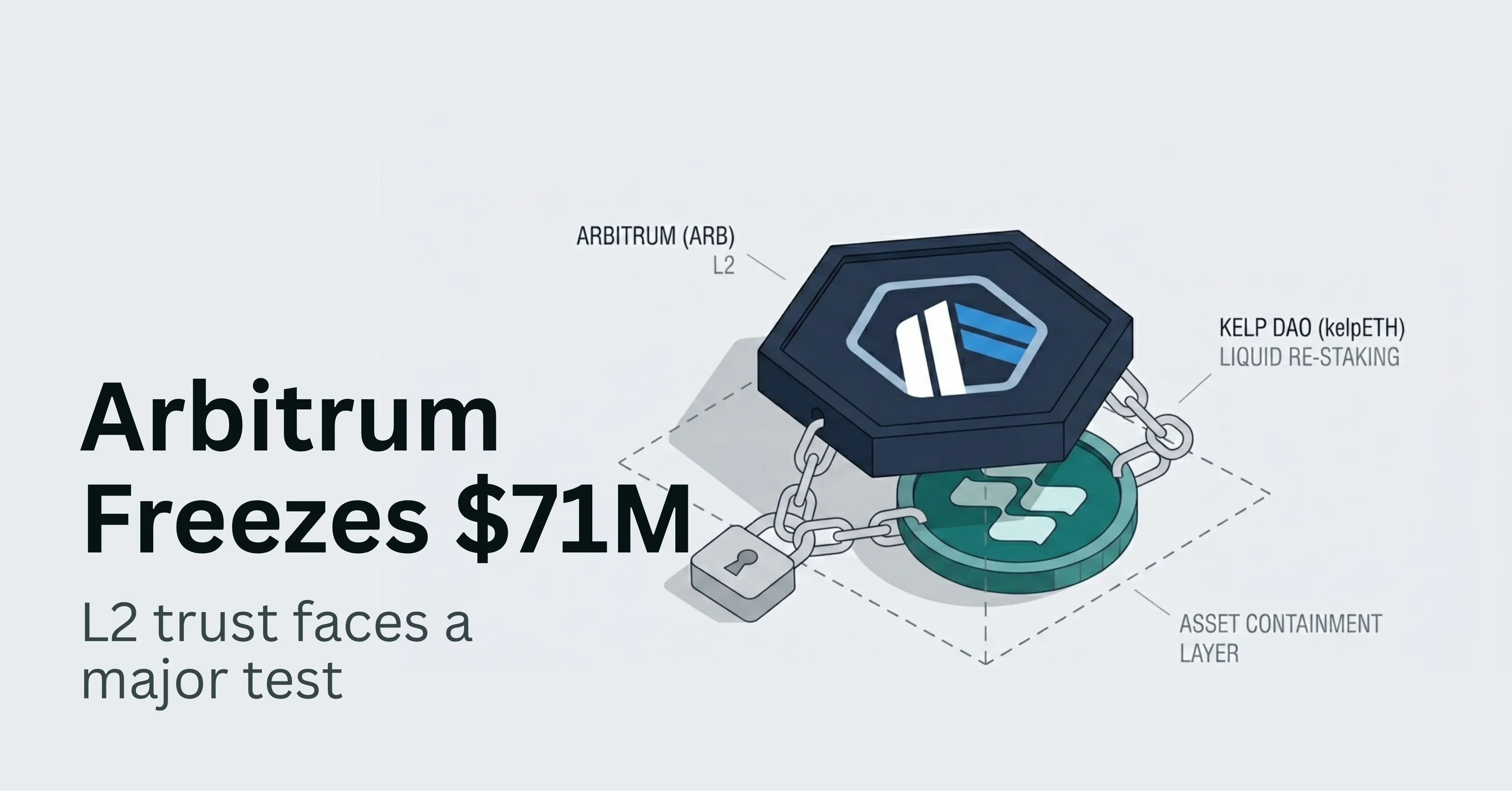
On April 20, 2026 Arbitrum's Security Council froze 30,766 ETH ($71M) from the Kelp DAO exploit. Audit your L2 trust assumptions before the next intervention.
Frequently Asked Questions
- On April 20 2026 at 23:26 Eastern Time, the Arbitrum Security Council executed a 9-of-12 multisig action that moved 30,766 ETH from an exploiter-controlled address on Arbitrum One into a governance-controlled intermediary wallet. The council cited input from law enforcement identifying the address as linked to the Kelp DAO rsETH bridge exploit of April 18 2026.
- A sequencer freeze operates at the L2 infrastructure layer through Security Council multisig action and is enforced on specific addresses without modifying the application contract. A protocol-native clawback is encoded inside the application contract itself, triggered by predefined conditions such as a pause admin, a recovery module, or a TRON-style reversible transaction list. The first centralises trust at the rollup operator, while the second centralises trust at the application deployer.
- Article 68 of Regulation (EU) 2023/1114 (MiCA) requires every authorised crypto asset service provider to meet the ICT resilience requirements of Regulation (EU) 2022/2554 (DORA). DORA Article 19 requires an authorised entity, including a CASP under MiCA, to report a major ICT-related incident to the competent authority without undue delay and to inform clients whose financial interests are affected by the incident or by the mitigation action taken.
Don't Miss What's Next
Subscribe to newsletter
Tags:
Arbitrum Security Council
L2 sequencer freeze
Kelp DAO exploit
BOLD fraud proofs
Timeboost
Nitro sequencer
L2 censorship resistance
LayerZero DVN
Stage 1 rollup
MiCA DORA compliance
DeFi
Get in Touch
Our team will get back to you within 24 hours.