ERC-8004 Production Architecture: Deployment Lessons
Table of Contents
Table of Contents
Share
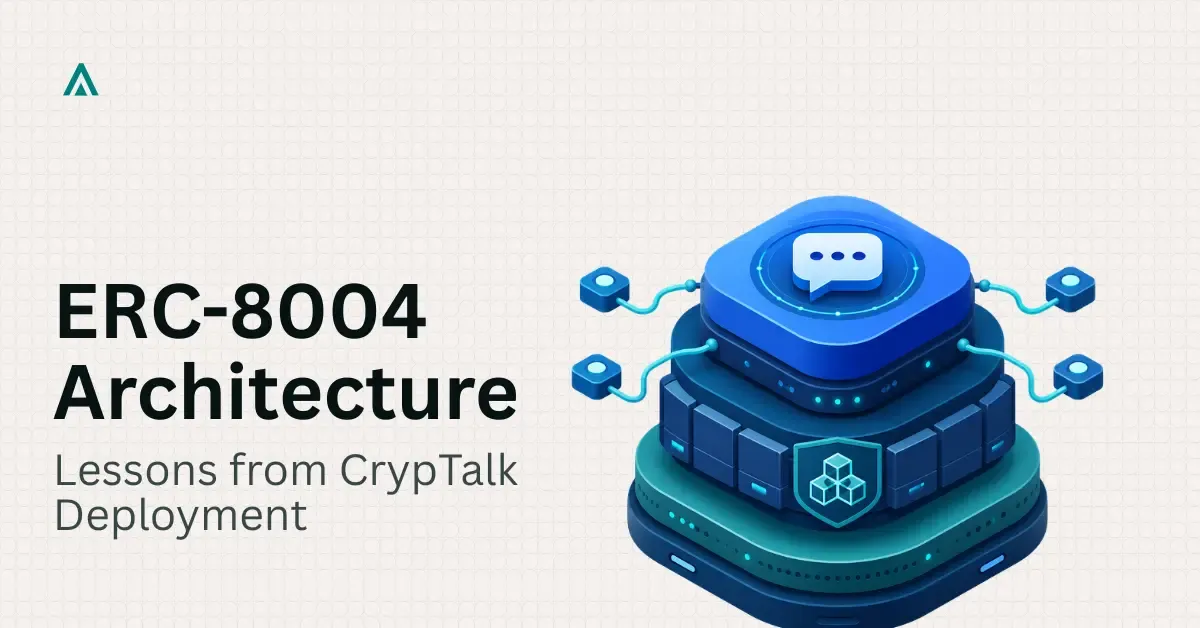
ERC-8004 production architecture: real gas, storage, and validator tradeoffs from a live agent registry deployment, benchmarked for CTOs shipping in 2026.
Frequently Asked Questions
- Identity Registry registration on an L2 such as Arbitrum or Base typically costs a fraction of a cent per agent, while mainnet registration cost depends heavily on network congestion at call time. Reputation feedback writes and validation requests add incremental gas per call, so most production teams batch feedback submissions and cache validation results off-chain to control cost at scale.
- ERC-8004 stores signed feedback pointers and optional aggregated scores on-chain while the evidence files and raw scoring logic stay off-chain. This keeps gas costs predictable and lets teams iterate on reputation algorithms without redeploying contracts, as long as the signed feedback hash anchors the off-chain evidence to an immutable on-chain record.
- The Validation Registry supports stake-secured re-execution, zkML proofs, and TEE attestation as pluggable trust models. Choice of validator type changes the cost and latency profile: re-execution is cheapest but slowest for complex agent logic, zkML proofs cost more to generate but verify quickly on-chain, and TEE attestation trades cryptographic guarantees for lower compute overhead.
Don't Miss What's Next
Subscribe to newsletter
Tags:
ERC-8004
Agent Architecture
Trustless Agents
Agentic Web3
Ethereum
AI Agent Infrastructure
AI Agents
Get in Touch
Our team will get back to you within 24 hours.