Gen AI + On-Chain Data: Autonomous Analytics Agents
Table of Contents
Table of Contents
Share
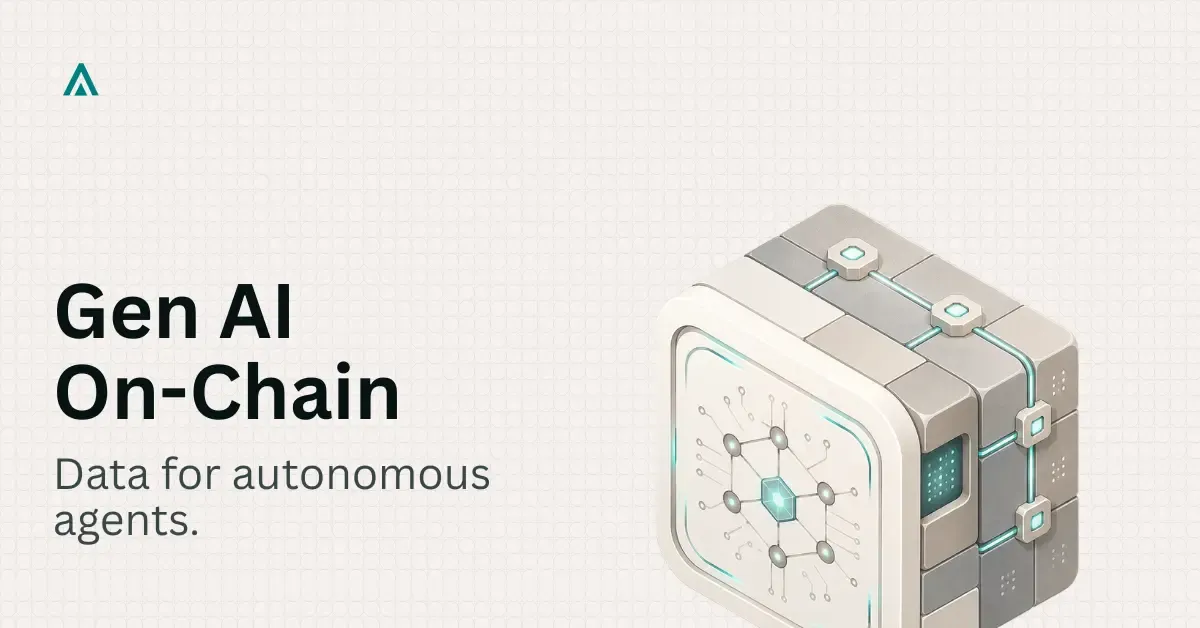
Build autonomous analytics agents on-chain with The Graph, Substreams, LangChain, and pgvector. A technical architecture guide for CTOs shipping in 2026.
Frequently Asked Questions
- An autonomous on-chain analytics agent is a software system that combines a blockchain data indexer (such as The Graph or Substreams), an LLM reasoning engine, and a tool-calling interface to continuously query, interpret, and act on on-chain data without manual intervention. It ingests raw event logs, transforms them into structured or vectorised representations, and executes conditional actions such as alerts, rebalances, or governance votes based on LLM-driven reasoning.
- Traditional dashboards are passive: they display pre-defined metrics and require a human analyst to interpret patterns and take action. Autonomous analytics agents are active: they subscribe to on-chain event streams in real time, use an LLM to reason across multiple data sources simultaneously, and trigger on-chain or off-chain actions autonomously. They also support natural-language queries against live chain state, which dashboards cannot do without manual SQL authoring.
- Choose The Graph subgraphs when you need a stable GraphQL API backed by a decentralised network with economic guarantees. Choose Substreams when you need sub-second streaming throughput and custom Rust transformation modules with parallel processing. Choose Envio HyperIndex when you need the fastest cold-start for EVM chains and want TypeScript-native handlers without Rust. For most autonomous agent architectures, Substreams feeds the real-time loop while a subgraph serves as the historical query layer.
- Agents that execute transactions autonomously may fall under FATF Recommendation 16 Travel Rule obligations if they relay value transfers. Under MiCA Article 30, any system providing crypto-asset services in the EU must implement KYC and transaction monitoring. DORA Article 19 mandates incident reporting for digital operational disruptions affecting financial services. Additionally, private key material used by agents must be secured under NIST SP 800-57 key management standards.
Don't Miss What's Next
Subscribe to newsletter
Tags:
Gen AI
On-Chain Data
Autonomous Agents
The Graph
LangChain
Web3 Analytics
AI Agents
Get in Touch
Our team will get back to you within 24 hours.