AI-Driven Yield Optimization on ERC-4626: Vault Design
Table of Contents
Table of Contents
Share
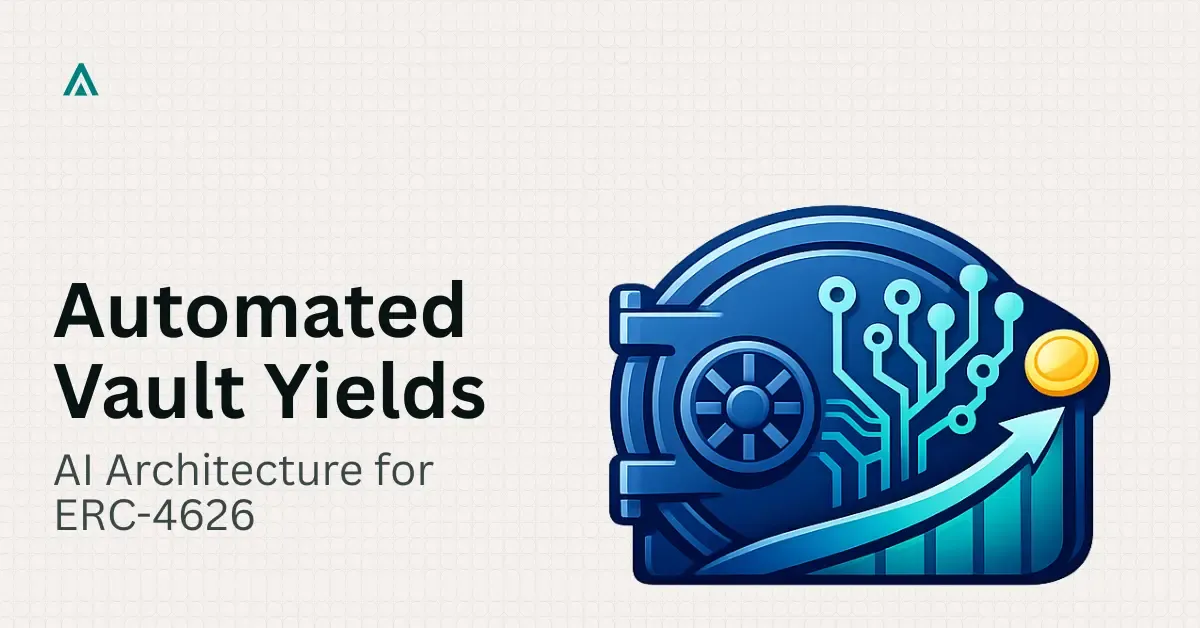
Audit-grade blueprint for AI-driven ERC-4626 vaults: strategy allocators, oracle guards, and rebalance invariants engineers must verify before mainnet.
Frequently Asked Questions
- It is a tokenized vault built to the ERC-4626 standard where an off-chain or co-processor-driven agent selects strategy allocations, and the on-chain contract enforces the deposit, withdrawal, and share-price invariants defined by the standard regardless of which strategy the agent picks.
- A static aggregator hardcodes allocation weights and rebalances on a fixed schedule or governance vote. An AI-driven vault feeds live protocol, oracle, and risk data into a model that recomputes target weights continuously, then submits allocation changes through a constrained on-chain executor that caps single-transaction exposure and slippage.
- Teams running multi-strategy treasury or asset-management products who already have ERC-4626 experience, a risk team that can define hard caps for the model, and budget for a security review that specifically covers oracle manipulation and agent-authority boundaries, not only the vault math.
- In production designs the agent should never hold direct transfer authority. It should only be permitted to call a constrained rebalance function that checks position caps, oracle staleness, and slippage bounds on-chain, with a timelocked path for any parameter the agent cannot override.
Don't Miss What's Next
Subscribe to newsletter
Tags:
ERC-4626
DeFi
AI Agents
Vault Architecture
Smart Contract Security
Get in Touch
Our team will get back to you within 24 hours.