How to Implement Post-Quantum Signatures in Solidity
Table of Contents
Table of Contents
Share
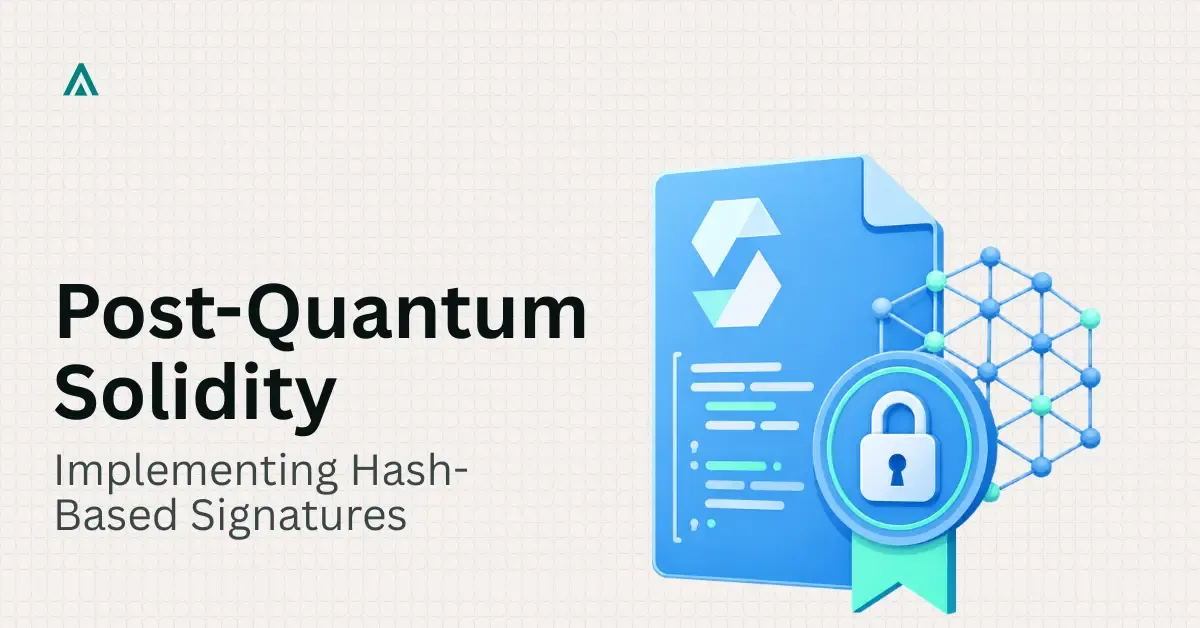
A 2026 operator guide to ML-DSA signature verification in Solidity: gas costs, EIP-8051 precompiles, audit scope, and a 10-week build and rollout plan.
Frequently Asked Questions
- Yes, if your wallets use ERC-4337 account abstraction. Validation logic lives inside the smart contract account, so a new validator module can accept ML-DSA signatures alongside ECDSA without changing the wallet address or moving funds. Externally owned accounts cannot be upgraded this way.
- A typical scope covers the validator contract, key storage or registry pattern, hybrid AND-mode signature logic, and testnet gas benchmarking. Most operators budget an audit tied to the complexity of their existing wallet architecture and whether social recovery is in scope, run alongside a phased mainnet rollout rather than a single cutover.
- Yes. Most teams pilot ML-DSA verification on one contract, treasury wallet, or product line first, benchmark gas cost and validation latency, then extend to the rest of the fleet over several weeks. A full-system cutover on day one carries the highest operational risk and is not recommended.
- Pure Solidity verification is possible but gas-expensive because the lattice math involves large polynomial operations. A dedicated precompile handles the heavy computation off the EVM's interpreted opcode path, which is why Ethereum's proposed precompile route is the practical option for production contracts today.
Don't Miss What's Next
Subscribe to newsletter
Tags:
post-quantum cryptography
Solidity
smart contract security
Smart Contracts
Get in Touch
Our team will get back to you within 24 hours.