Autonomous DeFi Agent Strategies for Self-Optimising Vaults
Table of Contents
Table of Contents
Share
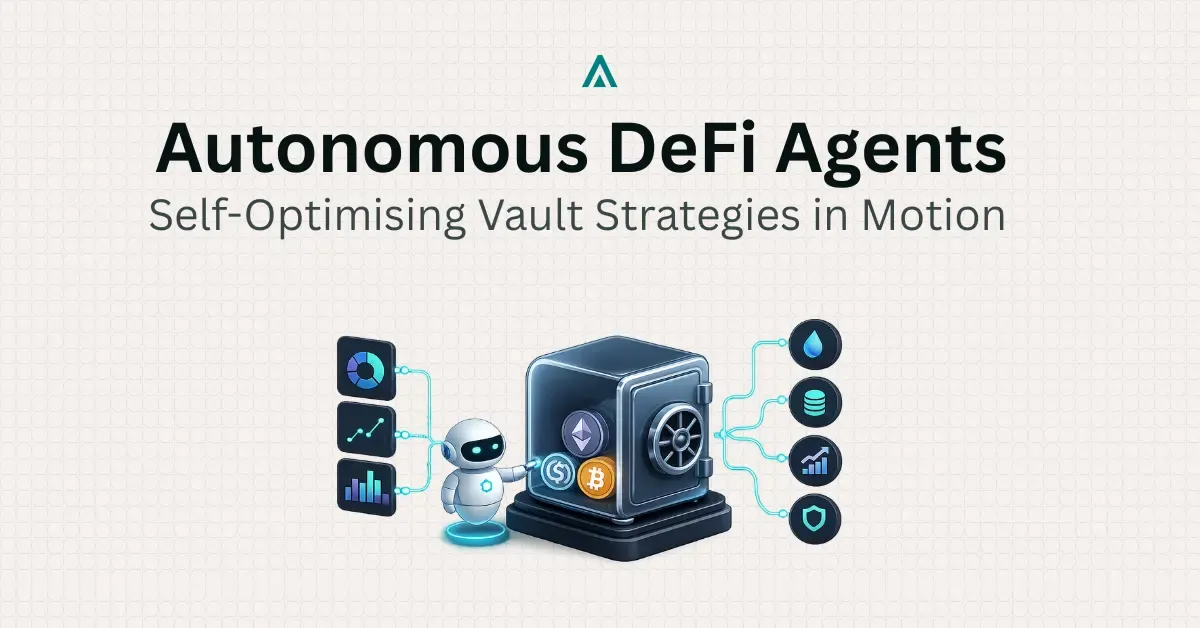
ERC-4626 plus ERC-7540 async flows, agent control loops, and on-chain circuit breakers: architect and audit self-optimising yield vaults the agent cannot drain.
Frequently Asked Questions
- The main failure modes are exchange-rate manipulation through donation and share-inflation attacks against the ERC-4626 conversion logic, oracle manipulation that misprices the strategy target, low-gas reentrancy introduced by transient storage guards, and agent logic that rebalances into an illiquid or compromised venue. Each must be bounded by an on-chain circuit breaker independent of the agent.
- A standard ERC-4626 vault exposes deposit, mint, withdraw, and redeem with a fixed or governance-set strategy. An agent-controlled vault adds an off-chain decision loop that observes yields and risk signals, then submits rebalance transactions through a constrained executor. The vault contract enforces invariants such as allocation caps and slippage bounds so the agent cannot exceed its mandate.
- Run the decision logic off-chain for cost and model flexibility, and enforce the result on-chain. The agent computes the target allocation off-chain, but the vault validates every move against hard-coded bounds, allocation caps, and a circuit breaker. Putting full optimisation on-chain is rarely worth the gas, while putting enforcement off-chain removes the only trust-minimised guarantee users have.
Don't Miss What's Next
Subscribe to newsletter
Tags:
DeFi Agents
ERC-4626
Yield Vaults
Get in Touch
Our team will get back to you within 24 hours.