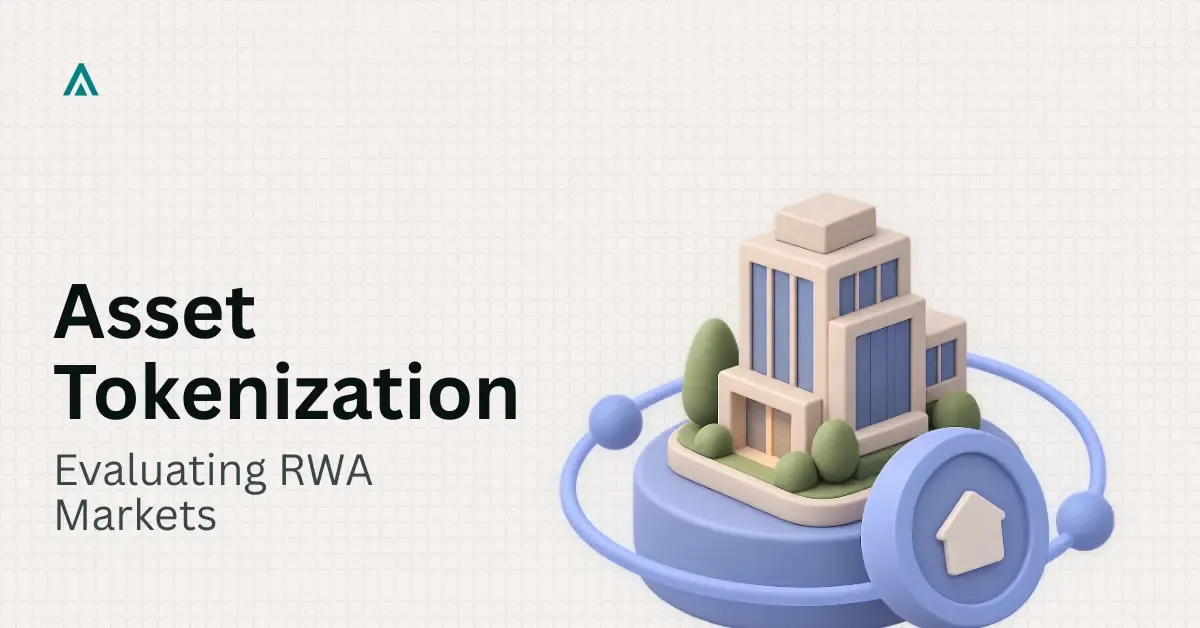
RWA Tokenization: What It Is, How It Works and Why It Matters in 2026
Table of Contents
Table of Contents
Share
Assess RWA tokenization against 2026 data: $27.5B on-chain excluding stablecoins, real build costs, and the compliance architecture operators need first.
Frequently Asked Questions
- RWA tokenization is the process of issuing a blockchain token that represents a legal claim on a physical or financial asset such as a Treasury bill, a property, a commodity or a private credit position. The token is not the asset itself. It is a transferable record of ownership whose legal enforceability depends entirely on the contractual and custodial structure built underneath it, which is why the legal work matters as much as the smart contract.
- Tokenized real-world assets excluding stablecoins reached roughly 27.5 billion dollars by the end of Q1 2026, up about 30 percent from 21 billion dollars at the start of the year. Tokenized US Treasuries are the largest single category at 13.4 billion dollars, followed by commodities at 7.3 billion dollars. Including stablecoins adds hundreds of billions more in tokenized dollar value.
- Build only when the asset class, jurisdiction or transfer rules are genuinely unusual, or when tokenization is the product rather than a feature. For a single standard asset class in one regulated market, an existing issuance platform is faster and cheaper. The deciding factor is rarely the smart contract, which is commodity work in 2026. It is whether your compliance and identity requirements fit what an off-the-shelf platform already enforces.
Don't Miss What's Next
Subscribe to newsletter
Tags:
RWA tokenization
asset tokenization
tokenized treasuries
MiCA compliance
RWA
Get in Touch
Our team will get back to you within 24 hours.