Fine-Tuning Cost Model for Retail Demand Forecasting
Table of Contents
Table of Contents
Share
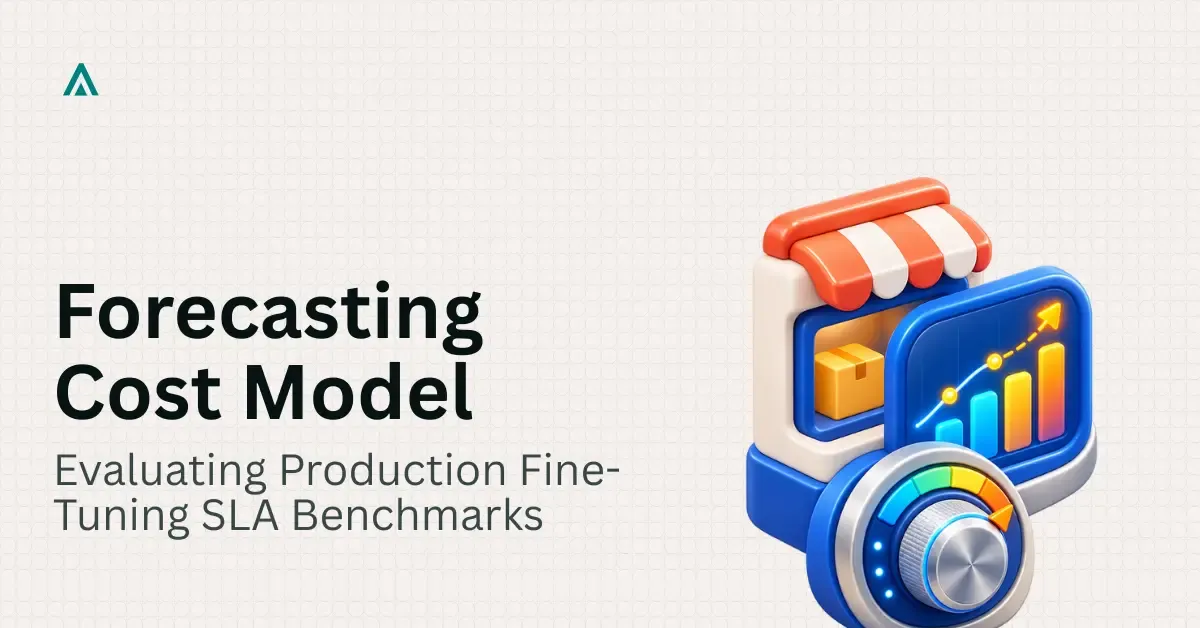
Scope a production fine-tuning budget for retail demand forecasting: build a $60K-$180K plan, verify HELM-aligned SLA targets, and audit the build vs buy math.
Frequently Asked Questions
- Projects of this scope typically range from USD 60,000 to USD 180,000 for the initial build, covering data preparation, adapter fine-tuning compute, evaluation harness construction, and shadow-mode validation, depending on SKU count and how many regional demand patterns the model needs to learn. Ongoing serving and retraining then run USD 10,000 to USD 30,000 a month depending on inference volume and how often the forecast horizon needs a refresh cycle.
- Yes. A scoped MVP that fine-tunes a single category, such as fast-moving grocery SKUs or one fashion line, typically costs USD 15,000 to USD 35,000 and takes 4 to 6 weeks, letting a retailer validate accuracy gains against its existing statistical forecast before committing to the full multi-category rollout and its larger infrastructure line items.
- Evaluation cost covers building a held-out benchmark harness modeled on HELM-style efficiency and accuracy scenarios, running mean absolute percentage error checks against a statistical baseline, load-testing inference latency against the service level target, and documenting the results for the model risk file. Budget USD 10,000 to USD 25,000 for this phase on a mid-size retail deployment, separate from the base fine-tuning compute cost.
Don't Miss What's Next
Subscribe to newsletter
Tags:
Fine-Tuning
Retail
Demand Forecasting
Cost Model
HELM Benchmark
Blockchain
Get in Touch
Our team will get back to you within 24 hours.