H100 Cluster Architecture for Healthcare Prior Auth AI
Table of Contents
Table of Contents
Share
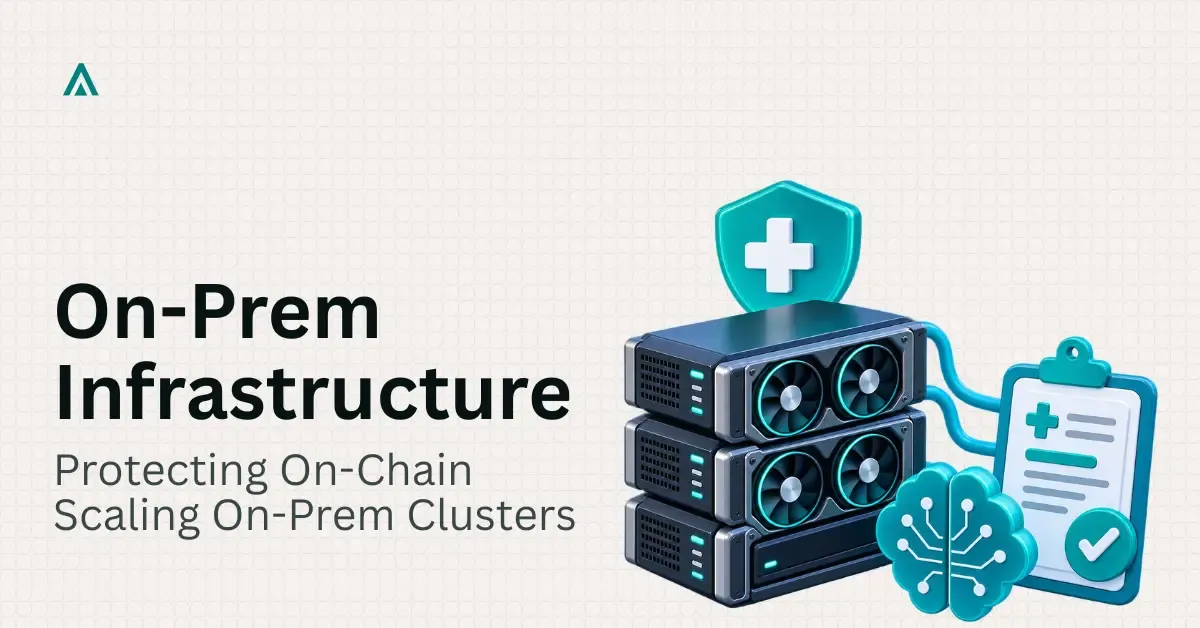
Build a HIPAA-compliant H100 cluster for prior authorization AI: 53M annual PA determinations in 2024, NVLink specs, and InfiniBand fabric. Architect the stack.
Frequently Asked Questions
- On-prem AI infrastructure for prior authorization is a dedicated cluster of GPU servers, typically built on NVIDIA H100 accelerators, that a hospital, payer, or revenue-cycle vendor owns and operates inside its own data center or a single-tenant colocation facility instead of a shared public cloud region. The cluster runs large language models that read clinical notes, payer policy documents, and claim history to draft or auto-adjudicate prior authorization requests. Owning the hardware keeps protected health information off multi-tenant infrastructure and gives the compliance team direct control over encryption keys, audit logs, and data residency, which is difficult to guarantee contractually on a shared cloud GPU instance.
- Cloud GPU instances such as AWS EC2 P5 rent NVIDIA H100 or H200 accelerators by the hour on shared or dedicated multi-tenant infrastructure, giving fast provisioning and elastic scaling at a premium hourly rate. An on-prem H100 cluster requires capital upfront and a longer procurement and rack-and-stack cycle, but it gives fixed monthly cost after breakeven, physical custody of PHI-bearing storage, and a fabric the compliance team can inspect end to end. For steady, high-volume prior authorization traffic that runs continuously rather than in bursts, the on-prem model typically reaches cost parity with reserved cloud instances within 14 to 20 months, after which every additional inference is materially cheaper.
- A mid-size health system processing 15,000 to 40,000 prior authorization requests a month can run production inference for a 70-billion-parameter class clinical reasoning model on a single 8-GPU H100 node, since the 80GB HBM3 per GPU and 900GB/s NVLink interconnect are sufficient for that request volume with room for retrieval-augmented context. Larger payers or multi-hospital networks processing millions of determinations a year typically deploy two to four 8-GPU nodes connected over InfiniBand to separate document ingestion, retrieval, and generation stages into independently scaled pools, which keeps p95 latency stable during enrollment-period traffic spikes.
Don't Miss What's Next
Subscribe to newsletter
Tags:
H100 cluster
prior authorization AI
on-prem AI infrastructure
HIPAA compliance
healthcare LLM
NVLink
InfiniBand
GPU cluster architecture
AI & Enterprise Use Cases
Get in Touch
Our team will get back to you within 24 hours.