Proof-of-Inference: OpenGradient Production Deployment
Table of Contents
Table of Contents
Share
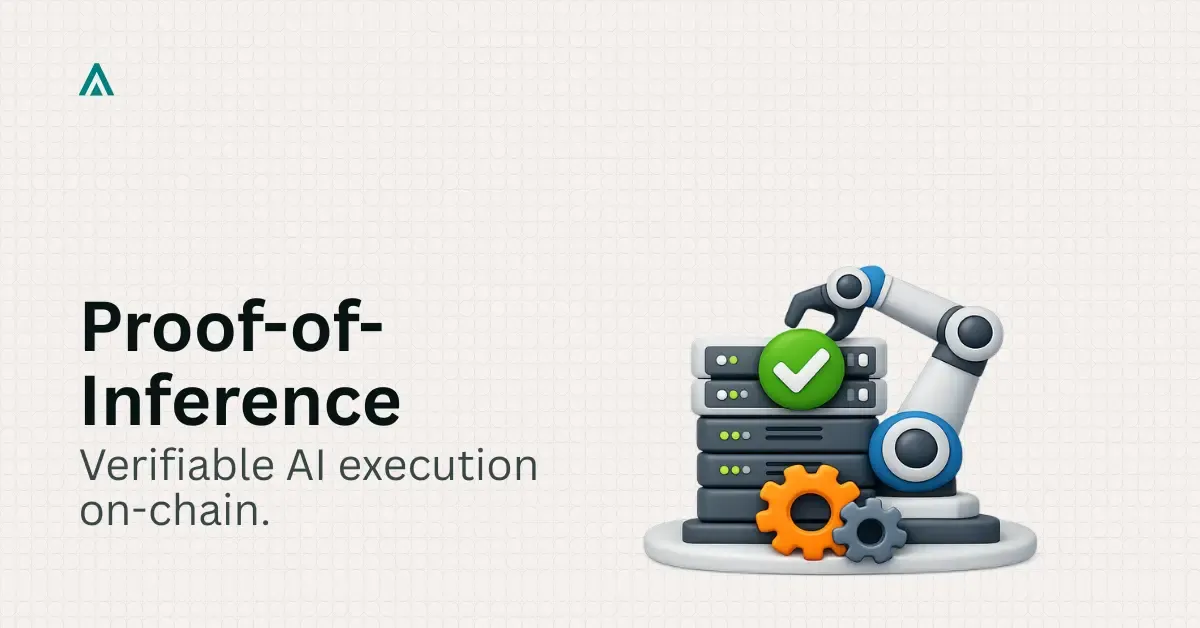
Deploy verifiable AI inference on-chain with OpenGradient HACA. 2026 production guide: SolidML compilation, 50,000-500,000 gas verification, inference nodes.
Frequently Asked Questions
- Proof-of-inference is a cryptographic mechanism that allows an on-chain smart contract to verify that a specific AI model produced a specific output from a specific input, without re-running the model on-chain. OpenGradient implements this via its HACA (Hybrid Attestation and Cryptographic Assurance) architecture, combining optimistic attestation with selective ZK verification to balance cost and security guarantees.
- SolidML is OpenGradient's domain-specific language for compiling trained ML models into verifiable on-chain representation. A model trained in PyTorch or ONNX format is compiled through the SolidML compiler into a model descriptor registered on the OpenGradient network, which inference nodes use to execute and attest computation. Smart contracts query the resulting inference outputs using the OpenGradient oracle interface.
- Gas costs for on-chain proof-of-inference verification on OpenGradient depend on verification mode. Optimistic mode costs approximately 50,000 to 80,000 gas per inference call for the on-chain attestation check. ZK verification mode adds a proof verification step costing 200,000 to 500,000 gas depending on model complexity and the proof system used. Production deployments typically default to optimistic mode with ZK escalation for high-value decisions only.
Don't Miss What's Next
Subscribe to newsletter
Tags:
Proof of Inference
OpenGradient
zkML
On-Chain AI
HACA Architecture
Blockchain
Get in Touch
Our team will get back to you within 24 hours.