Verifiable AI Inference with ZK Proofs: Architecture Guide
Table of Contents
Table of Contents
Share
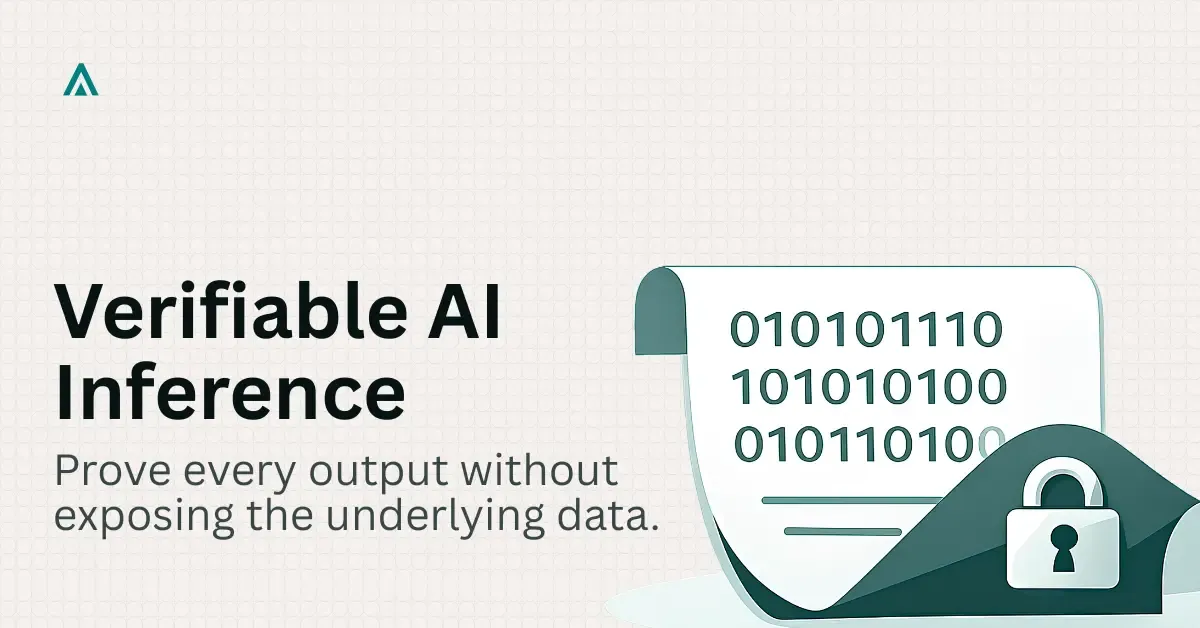
Verifiable AI inference proofs stay slow in 2024: 18M-parameter models take ~50s to prove with Plonky2. Compare EZKL, zkCNN, and audit real proof costs.
Frequently Asked Questions
- Verifiable AI inference with zero-knowledge proofs, often shortened to ZKML, is the practice of generating a cryptographic proof that a specific machine learning model produced a specific output from a specific input, without revealing the model weights or the input data. A smart contract or any third party can check the proof in milliseconds instead of re-running the model, which is what lets an on-chain application trust an off-chain AI computation without trusting the server that ran it.
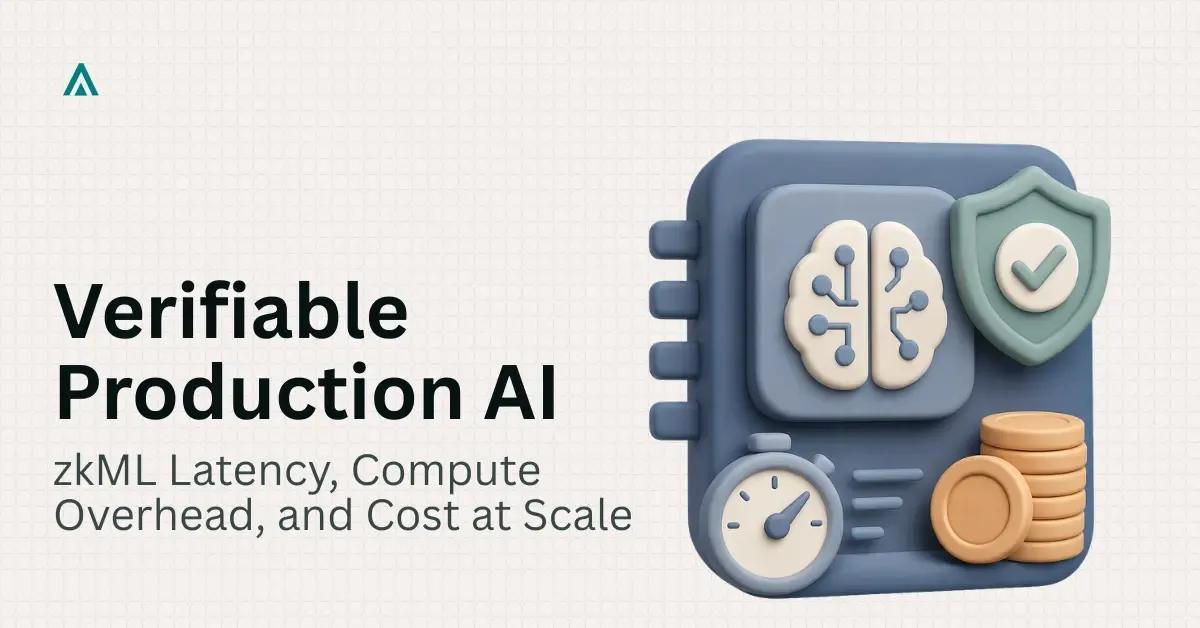
- Cost scales with parameter count, not with how useful the model is. Modulus Labs benchmarked six proof systems across models from 60,000 to 18 million parameters and found proof generation for an 18-million-parameter model took roughly 50 seconds on a well-provisioned AWS instance using Plonky2, with memory requirements in the tens of gigabytes. Smaller linear and tree-based models prove in well under a second, but production-scale transformer or vision models remain multiple orders of magnitude away from real-time proving.
- EZKL is the practical default for teams that already train in PyTorch or TensorFlow and export to ONNX, because it wraps the Halo2 proving system behind a CLI and Python bindings without requiring circuit-level cryptography expertise. Teams proving convolutional models exclusively, and who can invest in a specialized sumcheck-based prover, get faster linear-time proving from zkCNN-style architectures. The choice is a tradeoff between general-purpose tooling and workload-specific proving speed, not a single universal winner.
Don't Miss What's Next
Subscribe to newsletter
Tags:
ZKML
zero-knowledge proofs
verifiable AI inference
EZKL
on-chain AI
DeFi
Get in Touch
Our team will get back to you within 24 hours.