Solidity vs Rust: Smart Contract Language Guide 2025
Table of Contents
Table of Contents
Share
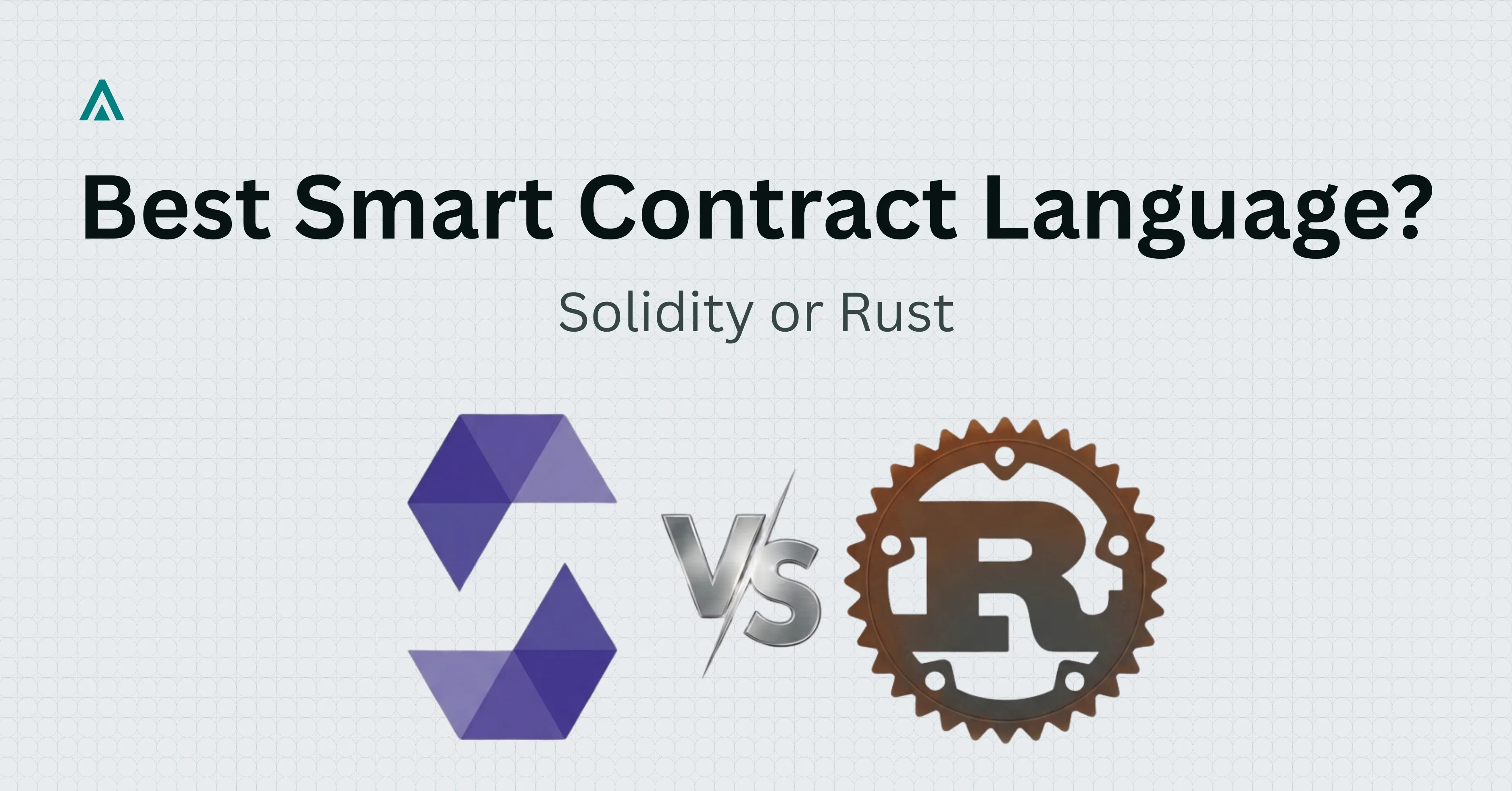
Solidity powers 100+ EVM chains. Rust dominates Solana with compiler-enforced safety. See 2024 data on developer ecosystems, exploits, and when to choose each.
Frequently Asked Questions
- They serve different chains. Foundry is a Solidity toolchain for EVM-compatible chains, fast, test-in-Solidity, excellent fuzzing. Anchor is a Rust framework for Solana that handles account validation, serialization, and CPI calls. The right choice depends entirely on your target chain: Foundry for Ethereum/EVM, Anchor for Solana. Both represent the current production standard for their respective ecosystems.
- Rust is the native contract language for three distinct ecosystems: Solana (Anchor framework), NEAR Protocol (near-sdk-rs), and the CosmWasm ecosystem spanning Osmosis, Secret Network, and Injective. Solana's SVM is by far the largest in TVL terms, reaching its highest DeFi TVL in early December 2024 before the broader market correction.
- Solidity's JavaScript-like syntax means most web developers can write a working ERC-20 contract within days. Rust takes longer. The ownership and borrowing system typically takes several weeks to internalize. Anchor abstracts much of the boilerplate, and the compiler's feedback loop becomes an asset once you stop treating it as an obstacle.
- Not directly. Rust targets the Solana Virtual Machine (SVM), NEAR's WebAssembly runtime, and CosmWasm chains, not the EVM. Arbitrum's Stylus allows Rust compiled to WASM to run on an EVM-compatible chain, but it remains an early-stage feature. If your target is Ethereum or any EVM-compatible chain, Solidity is the production-ready choice today.
- Rust has a structural edge at the compiler level. Its ownership model physically prevents shared mutable state, eliminating reentrancy as a class of bug. Solidity has matured significantly since 0.8.0, but its security depends heavily on developer discipline and external auditing. For DeFi protocols handling significant TVL, Rust compile-time guarantees reduce the exploit surface without relying on patterns the developer must remember.
Don't Miss What's Next
Subscribe to newsletter
Tags:
Solidity vs Rust smart contracts
Solidity tutorial
Rust blockchain
smart contract language comparison
Web3 Developer Tooling
Blockchain
Get in Touch
Our team will get back to you within 24 hours.
![Top 10 Gen AI Tools for Web3 Developers in 2026 [Ranked]](https://images.ancilar.com/Blog_Thumbnails_Variations_23_c4314cdbd9.webp)