Go Concurrency Patterns: The Production Engineer's Guide
Table of Contents
Table of Contents
Share
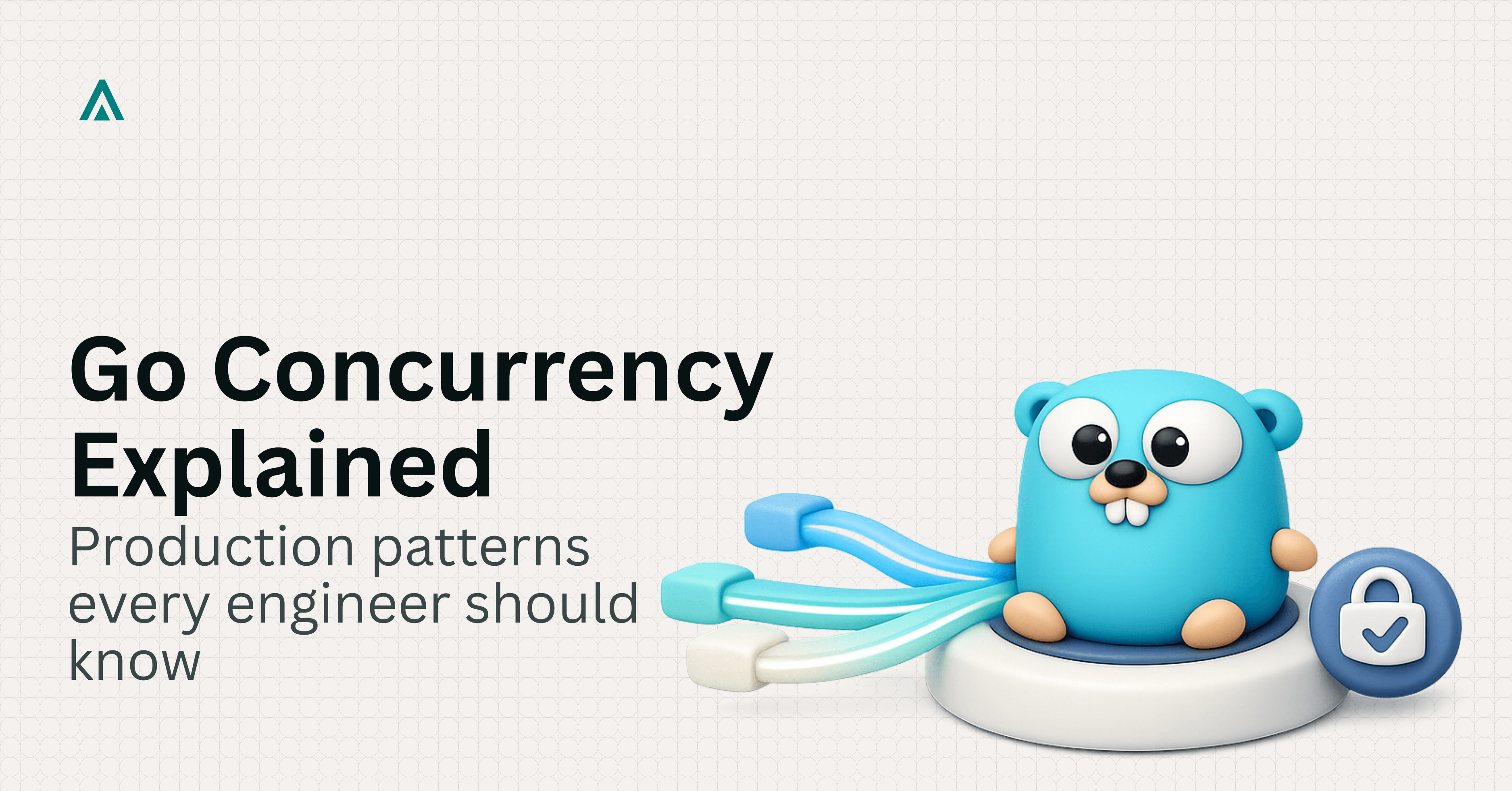
Build production Go concurrency patterns: goroutines, channels, worker pools, pipelines, and context cancellation with code walkthroughs. Updated August 2025.
Frequently Asked Questions
- Concurrency is the composition of independently executing processes that can make progress in overlapping time periods; parallelism is the simultaneous execution of multiple computations. Go's scheduler multiplexes goroutines onto OS threads, enabling both: concurrency by design, and parallelism when GOMAXPROCS allows multiple threads to run simultaneously.
- Use unbuffered channels when you need strict synchronization: the sender blocks until the receiver is ready, guaranteeing handoff. Use buffered channels to decouple sender and receiver temporarily, allowing the sender to proceed without waiting for an immediate consumer, up to the buffer capacity. Buffered channels work well in producer-consumer pipelines where burst traffic is expected.
- The context package creates a tree of control. When a parent context is cancelled via cancel() or when its deadline expires, all child contexts derived from it receive the cancellation signal through their Done() channel. Each goroutine should select on ctx.Done() alongside its work channel so it can exit cleanly when cancellation propagates, preventing goroutine leaks and wasted compute.
- The worker pool pattern maintains a bounded, fixed set of goroutines that pull work from a shared jobs channel. Use it when system resources such as memory, CPU, or external API rate limits constrain how many parallel operations can run safely. It prevents goroutine proliferation under load, which is critical for services handling unbounded input streams like REST handlers or queue consumers.
- The preferred approach is to share state only through channels, following Go's philosophy of communicating by sharing rather than sharing memory. When shared mutable state is unavoidable, use sync.Mutex for exclusive access or sync.RWMutex when reads dominate. Run go test -race during development to detect data races automatically. For simple counters and flags, sync/atomic offers lock-free operations with lower overhead than a mutex.
Don't Miss What's Next
Subscribe to newsletter
Tags:
Go Concurrency
Goroutines
Go Channels
Go Worker Pool
Go Pipeline Pattern
GoLang
Get in Touch
Our team will get back to you within 24 hours.

![Top 10 Gen AI Tools for Web3 Developers in 2026 [Ranked]](https://images.ancilar.com/Blog_Thumbnails_Variations_23_c4314cdbd9.webp)