Rust Ownership and Borrowing: Complete Beginner's Guide
Table of Contents
Table of Contents
Share
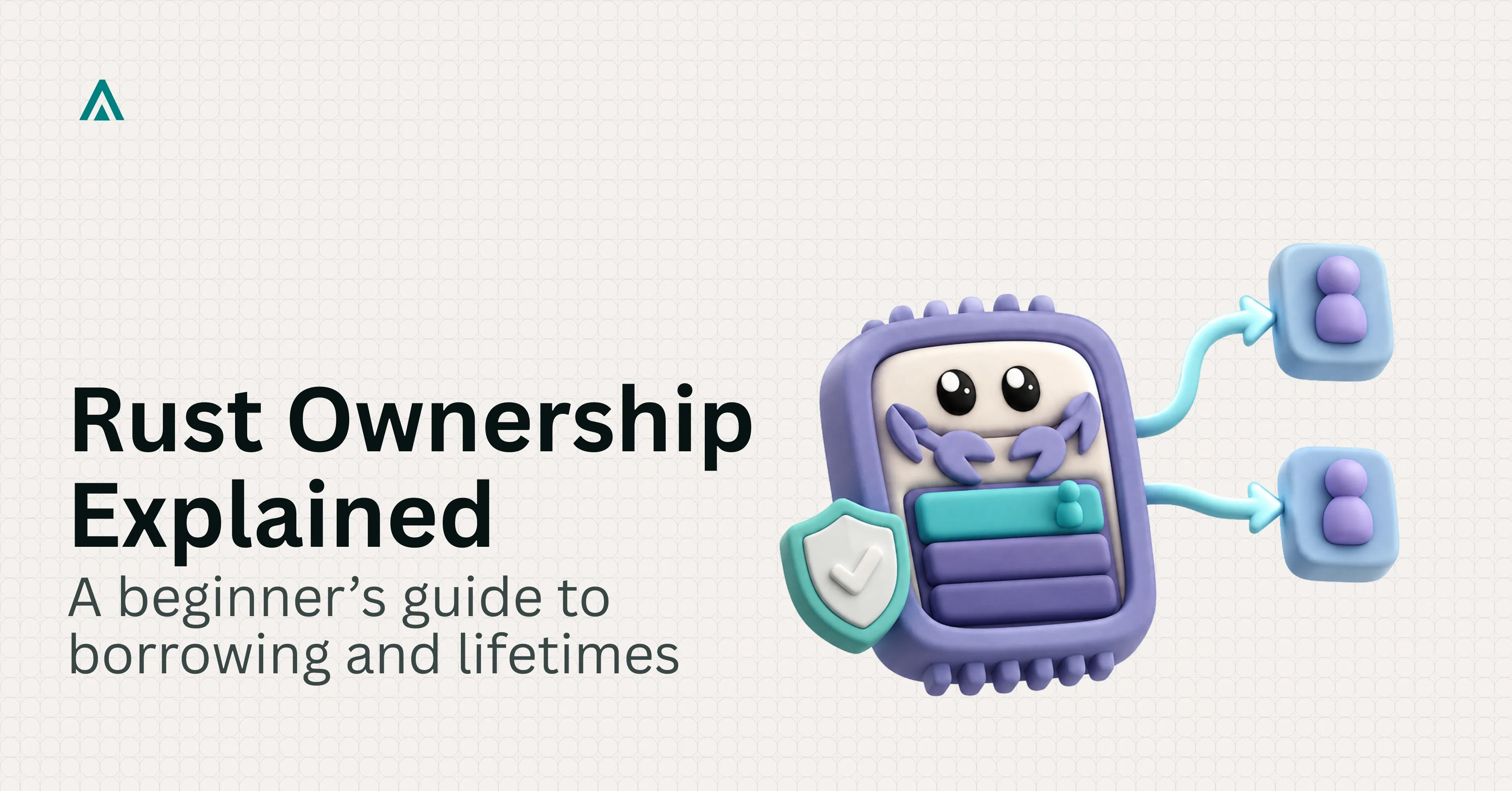
Learn Rust ownership and borrowing in 2025: move semantics, mutable references, borrow checker rules, and memory safety without garbage collection for Web3.
Frequently Asked Questions
- Ownership in Rust is a compile-time memory management system where every value has exactly one owner variable. When the owner goes out of scope, Rust automatically frees the memory. If you assign a heap-allocated value to another variable, ownership moves and the original variable becomes invalid.
- Moving transfers ownership permanently: the original variable becomes invalid. Borrowing uses a reference (& or &mut) to access the value temporarily without transferring ownership. After the borrow ends, the original owner retains full control of the value.
- No. Rust enforces that you can have either many immutable references or exactly one mutable reference at any point in time, never both simultaneously. This rule prevents data races at compile time without requiring locks or a runtime garbage collector.
- Rust's ownership and borrowing rules give the compiler enough information to insert memory deallocation code automatically at compile time. This means no runtime overhead from garbage collection pauses, making Rust suitable for latency-critical systems like blockchain validators, embedded firmware, and high-frequency trading engines.
- The borrow checker is a compile-time static analysis component in the Rust compiler that enforces ownership and borrowing rules. It verifies that references do not outlive the data they point to (no dangling pointers), that mutable and immutable borrows do not coexist, and that moved values are never used again.
Don't Miss What's Next
Subscribe to newsletter
Tags:
Rust programming
Rust ownership
Rust borrowing
Rust tutorial
Rust for beginners
memory safety
systems programming
Rust
Get in Touch
Our team will get back to you within 24 hours.

![Top 10 Gen AI Tools for Web3 Developers in 2026 [Ranked]](https://images.ancilar.com/Blog_Thumbnails_Variations_23_c4314cdbd9.webp)