LLM Fine-Tuning Brief: LoRA, QLoRA Cost of Domain Adaptation
Table of Contents
Table of Contents
Share
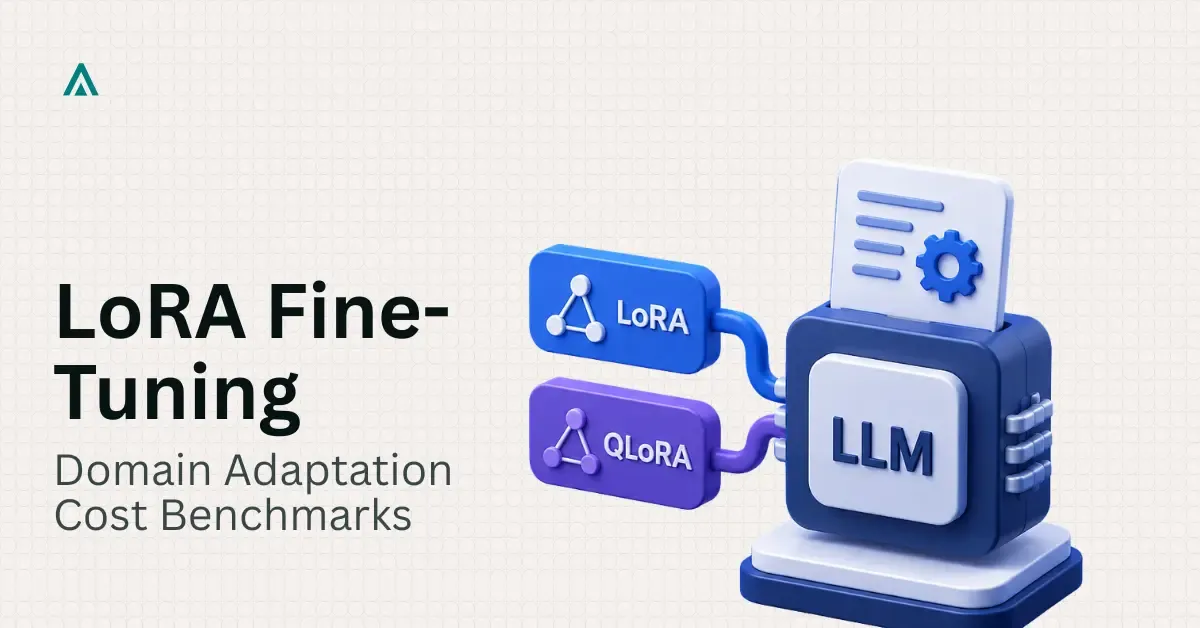
Assess LoRA and QLoRA fine-tuning economics before you build an enterprise LLM domain adaptation investment case for capital allocators in early 2024.
Frequently Asked Questions
- LoRA, or Low-Rank Adaptation, freezes the pretrained model weights and injects small trainable rank decomposition matrices into each transformer layer. The original LoRA paper reports trainable parameters cut by 10,000 times and GPU memory requirements cut by 3 times versus full fine-tuning of GPT-3 175B with Adam, while matching or beating full fine-tuning quality on RoBERTa, DeBERTa, GPT-2, and GPT-3 benchmarks.
- QLoRA adds 4-bit NormalFloat quantization, double quantization, and paged optimizers on top of the LoRA adapter method. This combination lets a 65B parameter model be fine-tuned on a single 48GB GPU while preserving full 16-bit finetuning task performance, which is the memory ceiling that makes domain adaptation affordable for teams without multi-GPU clusters.
- Capital allocators funding AI infrastructure, family offices backing applied-AI portfolio companies, and enterprise buyers comparing build-versus-buy for domain-specific models should model both approaches. The right choice depends on available GPU memory, dataset size, and whether checkpoint storage cost across many downstream tasks matters more than raw training speed.
Don't Miss What's Next
Subscribe to newsletter
Tags:
LLM Fine-Tuning
LoRA
QLoRA
AI Investment
AI Agents
Get in Touch
Our team will get back to you within 24 hours.