My Honest Take on ZKML: Impressive Tech, Unclear Revenue
Table of Contents
Table of Contents
Share
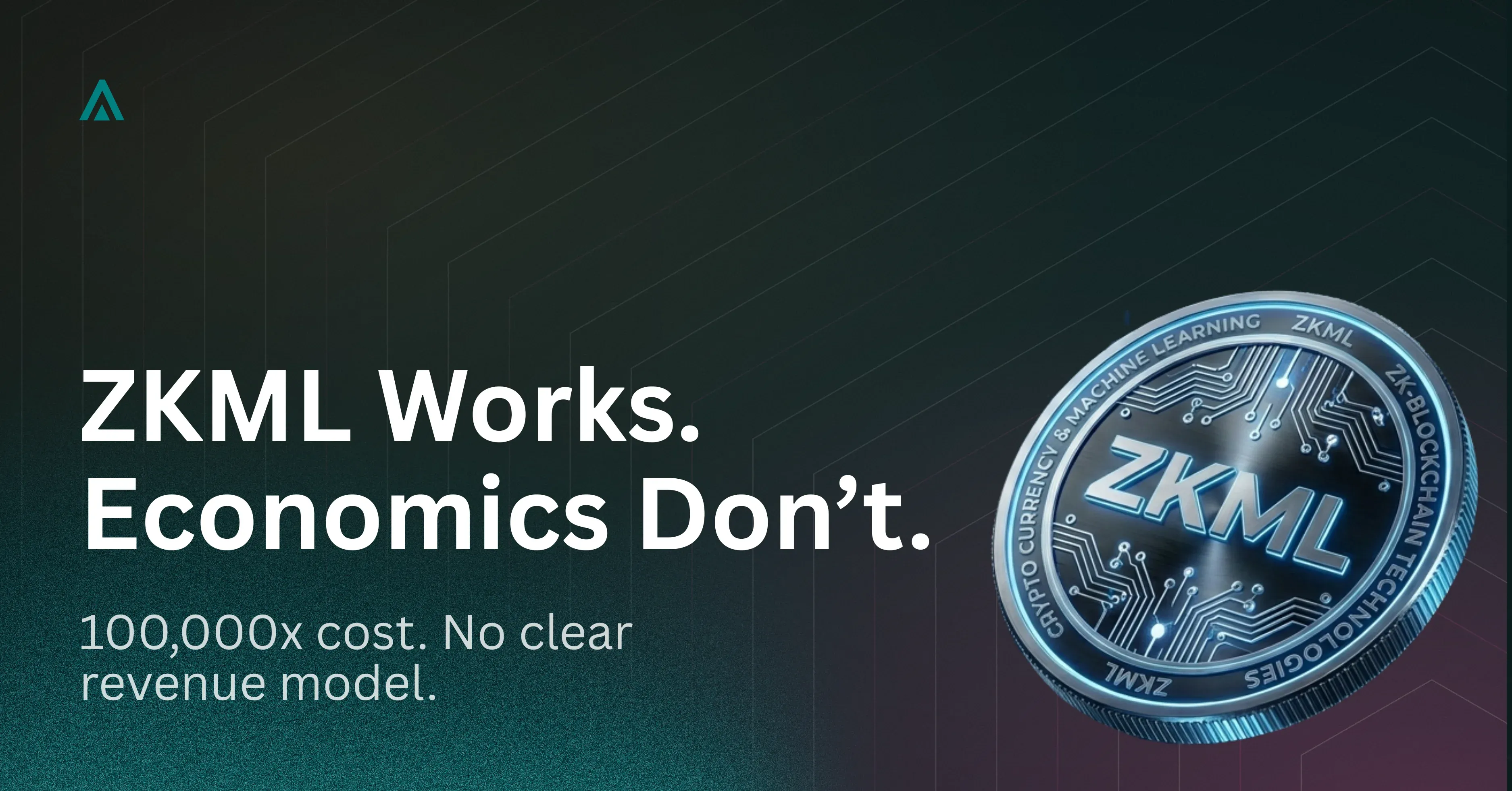
ZKML proves AI without exposing data, but who pays for ZK proof generation at scale? A founder's honest take: build cost, use cases, and revenue gaps in 2026.
Frequently Asked Questions
- ZKML lets a business prove that an AI model produced a specific output without revealing the model's weights, the input data, or any proprietary logic. For founders, this means you can offer verifiable AI decisions: loan approvals, risk scores, health screening results: to third parties who need cryptographic assurance rather than trust in your brand alone.
- For small-to-medium models in DeFi risk scoring and compliance reporting, yes: frameworks like EZKL are shipping production integrations. For complex transformers or large language models, the proof generation overhead is still between 10,000x and 100,000x standard inference time. A 2026 launch is feasible for narrow, well-scoped models; a full-scale LLM integration is 12 to 24 months away from practical deployment.
- Proof generation is typically priced per inference request and runs on GPU clusters. Today, the cost ranges from fractions of a cent for tiny models to several dollars per proof for medium-complexity networks. The sustainable business model requires charging a verifiability premium to end users: regulators, institutional counterparties, or compliance-obligated clients: who are willing to pay more for provable outputs versus standard black-box AI.
Don't Miss What's Next
Subscribe to newsletter
Tags:
ZKML
Zero Knowledge Machine Learning
AI Privacy
Web3 Founders
Verifiable AI
Get in Touch
Our team will get back to you within 24 hours.