Quantum Risk in Web3: A Founder's Migration Guide 2026
Table of Contents
Table of Contents
Share
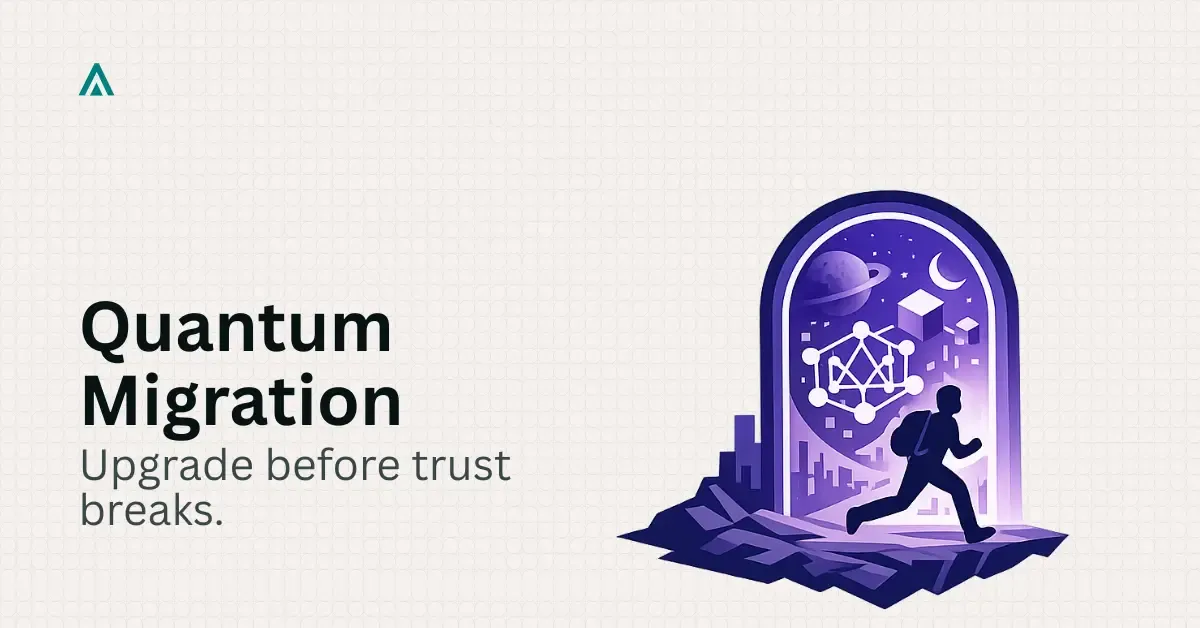
NIST finalized 3 PQC standards in 2024 to address ECDSA's quantum vulnerability. Audit your Web3 protocol's quantum exposure and build a PQC migration plan now.
Frequently Asked Questions
- Quantum risk is the threat that sufficiently powerful quantum computers will break the elliptic curve cryptography (ECDSA/secp256k1) underlying most blockchain wallet signatures and smart contract authentication. When that threshold is reached, any wallet whose public key is exposed on-chain becomes vulnerable to private key reconstruction, enabling theft of all funds without the owner's involvement.
- Post-quantum cryptography (PQC) replaces classical signature algorithms with schemes resistant to Shor's algorithm on quantum computers. NIST-standardised algorithms, ML-KEM (FIPS 203), ML-DSA (FIPS 204), and SLH-DSA (FIPS 205), use lattice-based or hash-based mathematics that no known quantum algorithm can break in polynomial time. Web3 protocols adopting these standards can sign transactions and authenticate wallets safely even in a post-quantum world.
- Founders should take three immediate steps: first, audit which smart contracts expose public keys on-chain and map those to at-risk wallet addresses; second, adopt NIST FIPS 203/204/205 PQC standards in new key management infrastructure before launching new contracts; third, plan a migration path for existing contracts that cannot be upgraded in place, including user communication timelines and multi-sig transition frameworks.
Don't Miss What's Next
Subscribe to newsletter
Tags:
Quantum Risk
Post-Quantum Cryptography
Web3 Security
Blockchain
PQC
Founders
Founder Blog
Get in Touch
Our team will get back to you within 24 hours.