DAI vs FRAX: PSM Architecture and Stability Design
Table of Contents
Table of Contents
Share
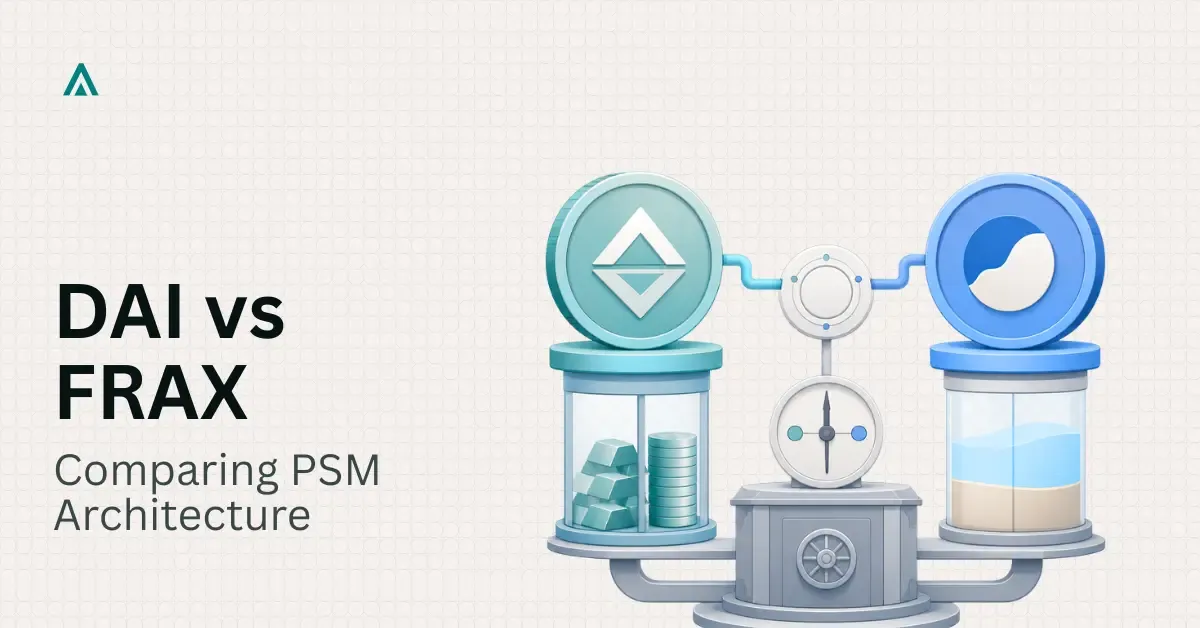
DAI fell to 88 cents in March 2023 on PSM reserve risk. Compare MakerDAO's PSM and FRAX's AMO architecture, then audit your stablecoin integration risk.
Frequently Asked Questions
- The MakerDAO Peg Stability Module lets users swap DAI for whitelisted stablecoins such as USDC at close to a 1:1 rate through a fee-adjustable contract, absorbing demand shocks by minting or burning DAI against those reserves. The FRAX Algorithmic Market Operations controller instead moves already-minted FRAX and collateral into yield strategies such as Curve pools, expanding or contracting supply based on whether FRAX trades above or below one dollar, without a direct 1:1 swap contract for a single reference asset.
- DAI relied on USDC for roughly 52 percent of its collateral reserves at the time, largely through the PSM. When Circle disclosed that a portion of USDC reserves sat at Silicon Valley Bank during its collapse, USDC itself lost its dollar peg, and DAI fell to an intraday low of 88 cents because the PSM directly ties DAI issuance to USDC's market price during redemption stress.
- FRAX v2 is fractional-algorithmic: part of its supply is backed by real collateral held in the protocol treasury and part is supported by algorithmic mechanisms controlled through AMO contracts. AMO controllers can adjust the effective collateral ratio without changing FRAX's price, using strategies such as the Curve AMO to deepen liquidity while keeping the peg intact.
- Following the March 2023 depeg, MakerDAO governance ran a parameter-normalization poll to rebalance fee-in and fee-out rates and debt ceilings across PSM-USDC-A, PSM-GUSD-A, and PSM-USDP-A, giving the protocol tools to shift new DAI issuance away from an overexposed reserve asset without an emergency shutdown.
Don't Miss What's Next
Subscribe to newsletter
Tags:
MakerDAO
DAI
FRAX
Peg Stability Module
DeFi Lending
DeFi
Get in Touch
Our team will get back to you within 24 hours.