Building UniTokenSwap's Intent-Based Trading Protocol
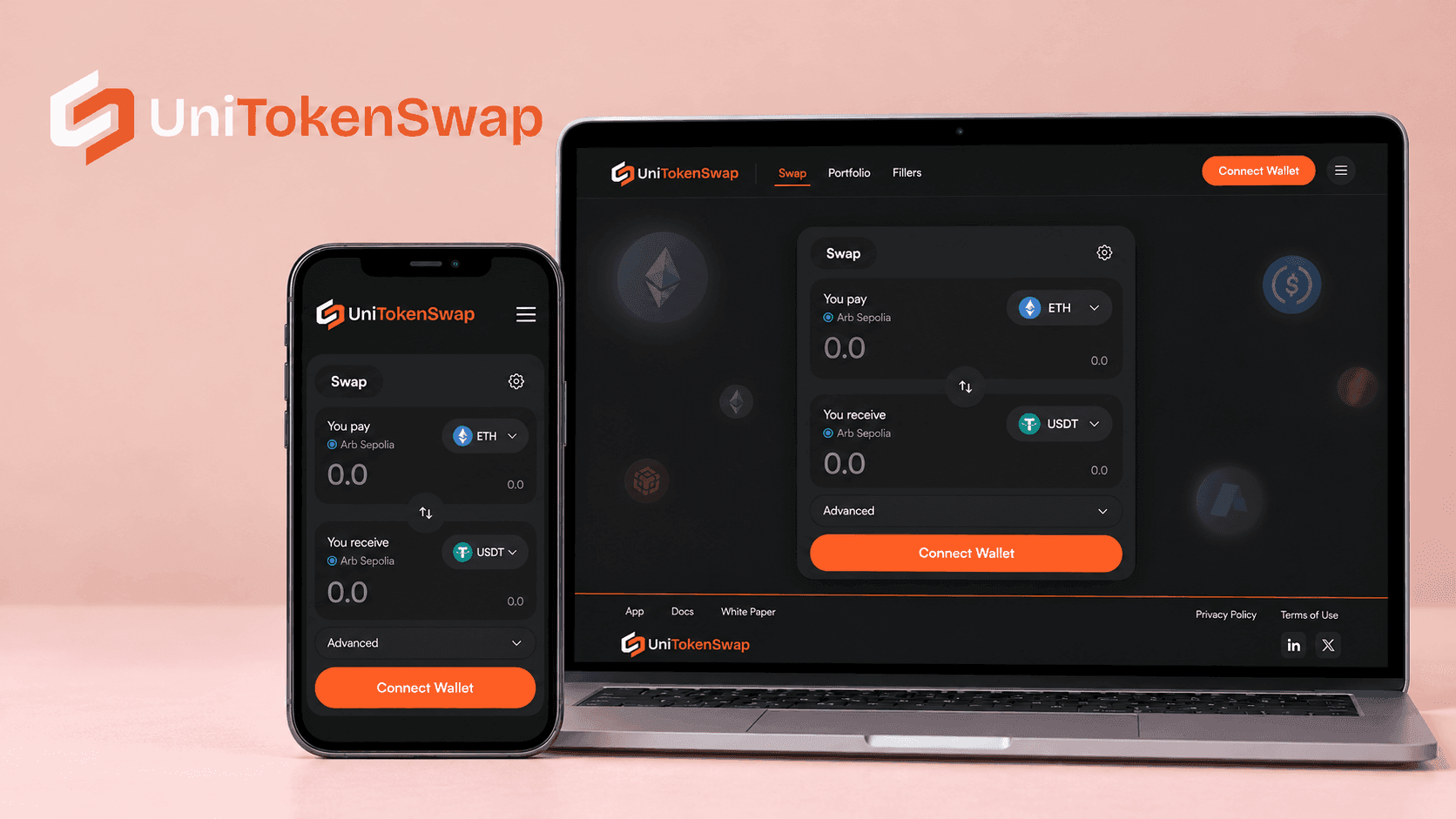
Ancilar built UniTokenSwap's settlement contracts, order coordination services, filler tooling and web app. The product runs on two test networks, Arbitrum Sepolia and Base Sepolia, where users sign swap orders and fillers submit supported executions.
- Team Size
- 5
- Arbitrum Sepolia and Base Sepolia
- 2 Testnets
- Delivery Scope
- Contracts, Services, App
Technical Implementation
Execution Summary
A five-person team delivered the protocol and application layers together, covering order pricing, settlement, cross-chain coordination and user-facing transaction status.
- 01
Dutch Auction Pricing
Each order's price moves across a set decay window, and fillers choose when to execute within the user's signed limits.
- 02
Signed Orders with Permit2
Users approve a token for Permit2 once per network, then sign each order as an EIP-712 message. Fillers submit the execution and pay its gas.
- 03
Cross-Chain Orders
Orders use an ERC-7683-style envelope. Source funds sit in escrow, the filler delivers on the destination chain, and repayment follows a completed settlement over Hyperlane.
- 04
Swap App and Filler Portal
A web app for swaps, order status and history, plus a portal where fillers register their executor and quote endpoint.
Tech Stack:
 Web Socket
 PostgreSQL
 Redis
 Ethereum
 Rust
 Solidity
 Foundry
 TypeScript
 Node.js
 DockerWeb SocketPostgreSQLRedisEthereumRustSolidityFoundryTypeScriptNode.jsDockerWeb SocketPostgreSQLRedisEthereumRustSolidityFoundryTypeScriptNode.jsDocker
FAQ
Frequently Asked Questions
The settlement contracts, the order coordination and filler services, and the swap and filler web app. A five-person team delivered all three layers.
No. It runs on the Arbitrum Sepolia and Base Sepolia test networks.
Yes, for some actions. Signing an order is free and fillers pay execution gas. The one-time Permit2 approval, any reclaim and any other transaction the user sends need gas from the user.
The source tokens are held in escrow. A filler delivers the output on the destination network and is repaid from escrow after settlement completes over Hyperlane.
A same-chain order expires and the tokens never leave the wallet. If escrowed funds are left after a fill times out, they become reclaimable through an on-chain call.
A clear proven process, that delivers
End of Scroll. Start of Discovery.
You've seen our ideas - now go deeper.
Discover more insights, guides, and engineering practice.