What Is a Decentralized Exchange? How DEX Architecture Works
Table of Contents
Table of Contents
Share
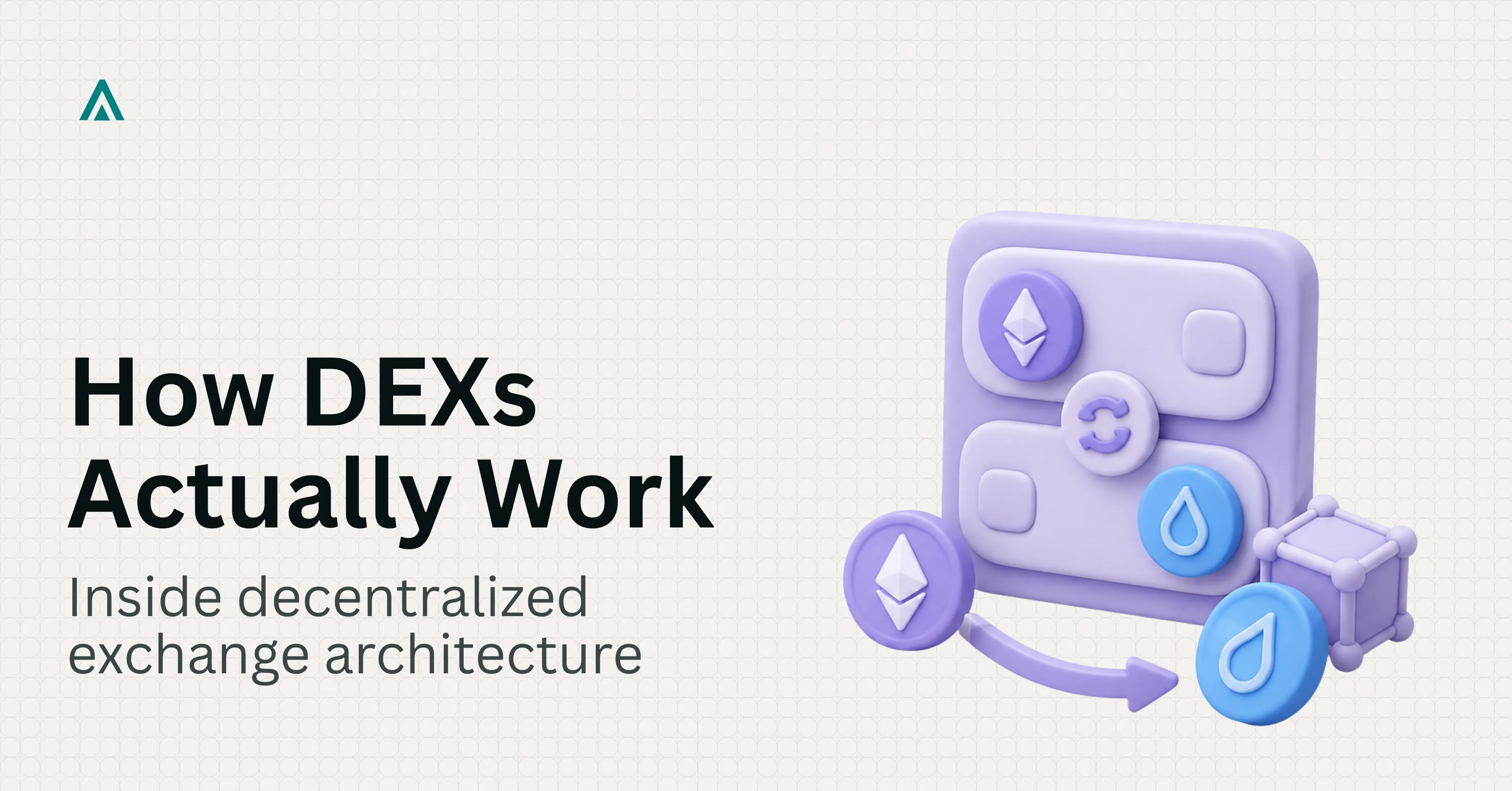
Build a production DEX in 2025: AMM curves, Uniswap v4 Hooks, EIP-1153 transient storage, intent-based trading, and compliance requirements explained.
Frequently Asked Questions
- A decentralized exchange (DEX) is a protocol that enables peer-to-peer token trading directly on-chain via smart contracts, with no custodial intermediary holding user funds. Unlike centralized exchanges, where a company controls the order book and custody, DEXs settle trades transparently on a public blockchain. Users retain control of their private keys throughout every transaction.
- Uniswap v4 is a programmable AMM that consolidates all liquidity pools inside a single PoolManager contract (Singleton pattern) and introduces Hooks: external contracts called at deterministic lifecycle points such as beforeSwap and afterSwap. For operators, Hooks enable custom fee logic, on-chain limit orders, MEV-aware rebalancing, and auto-compounding without forking the core protocol. The Singleton design also reduces multi-hop swap gas costs significantly compared to earlier factory-per-pool models.
- DEX operators targeting EU users must align with MiCA Regulation EU 2023/1114 Articles 76-80, which govern crypto-asset service providers and require disclosure, whitepaper filing, and AML screening for VASP-to-VASP transfers under the Travel Rule (FATF Recommendation 16, transposed in EU via Transfer of Funds Regulation 2023/1113). US-facing DEXs face SEC and CFTC scrutiny depending on whether listed assets qualify as securities or commodities. Smart contract code should be audited before any public launch to reduce liability exposure.
- In intent-based systems, users sign an off-chain message declaring the minimum output they will accept rather than submitting a specific routing transaction. Professional solvers compete to fill the order, often via Dutch auction mechanisms where the quoted price improves over time until a solver finds a profitable fill. Because users never broadcast a raw swap transaction, front-running bots cannot extract MEV by inserting transactions ahead of theirs in the mempool.
Don't Miss What's Next
Subscribe to newsletter
Tags:
DEX
Uniswap v4
Hooks
EIP-1153
DeFi
Smart Contracts
MEV
Get in Touch
Our team will get back to you within 24 hours.