Uniswap V3 Concentrated Liquidity: Production Architecture
Table of Contents
Table of Contents
Share
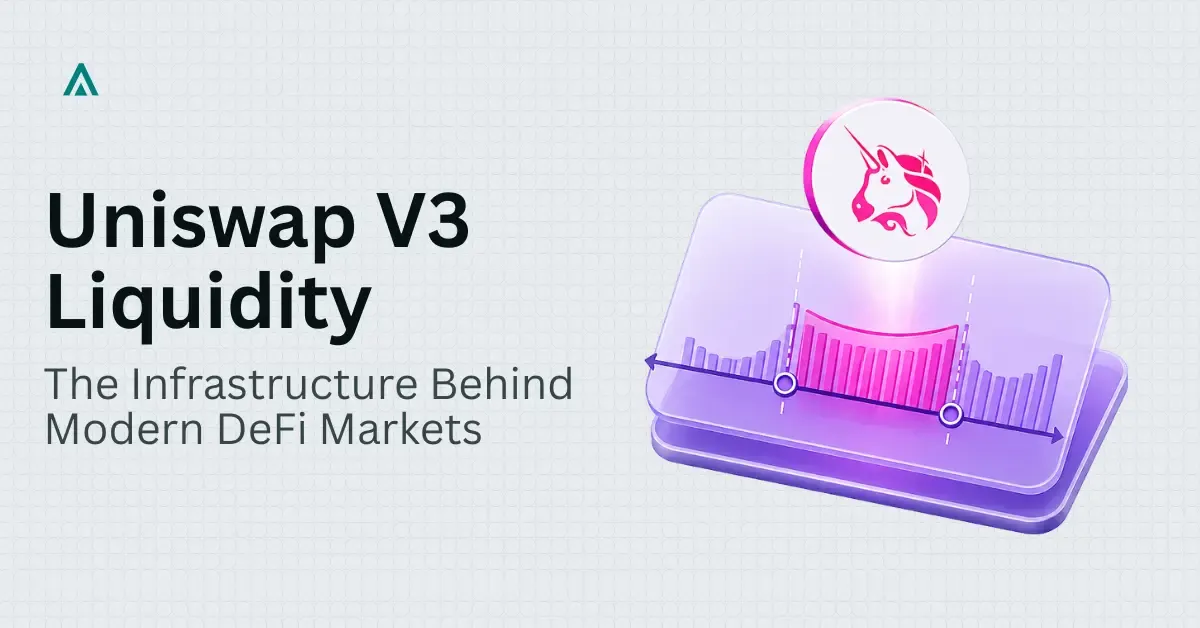
Uniswap V3 concentrated liquidity earns 4000x more fees per capital unit but needs active position management. Build production architecture for DeFi in 2024.
Frequently Asked Questions
- Concentrated liquidity in Uniswap V3 allows liquidity providers to allocate capital within a custom price range rather than across the full 0-to-infinity curve used in V2. When the market price trades within an LP's specified range, that capital earns fees as if the entire position were deployed at the current price. This makes capital up to 4000x more efficient than V2 for stable pairs trading in narrow bands, according to Uniswap Labs' May 2021 whitepaper. The tradeoff is that positions go inactive and stop earning fees if the market price moves outside the configured tick range, requiring active monitoring and rebalancing.
- Impermanent loss in Uniswap V3 is amplified compared to V2 because concentration increases delta exposure within the chosen range. A V3 LP providing liquidity in a narrow stable band experiences the same percentage loss from a small price move that a V2 LP would experience from a much larger move, because the V3 position has higher effective delta within its range. When price exits the range entirely, the position converts entirely to the declining asset and holds there until price re-enters the range. Teams must size ranges to balance fee income against this amplified divergence loss, typically using volatility data from Chainlink or on-chain TWAP feeds to set range width dynamically.
- Tick spacing in Uniswap V3 defines the minimum granularity at which liquidity boundaries can be set. Each fee tier maps to a specific tick spacing: the lowest fee tier uses spacing of 1, the next uses spacing of 10, the standard tier uses spacing of 60, and the highest fee tier uses spacing of 200. Tighter tick spacing allows more precise range targeting but increases gas cost because more tick crossings occur per swap. For production systems managing multiple positions, tick spacing determines how many rebalance transactions are needed to shift a position by a given price range, directly affecting operational gas costs. High-frequency rebalancing on tight-spacing tiers can incur substantial gas overhead if not batched efficiently.
Don't Miss What's Next
Subscribe to newsletter
Tags:
Uniswap V3
Concentrated Liquidity
DeFi
AMM
Solidity
Position Management
Web3 Architecture
ICP-3
Get in Touch
Our team will get back to you within 24 hours.