The February Wick: AI Agent Coordination Failure in DeFi
Table of Contents
Table of Contents
Share
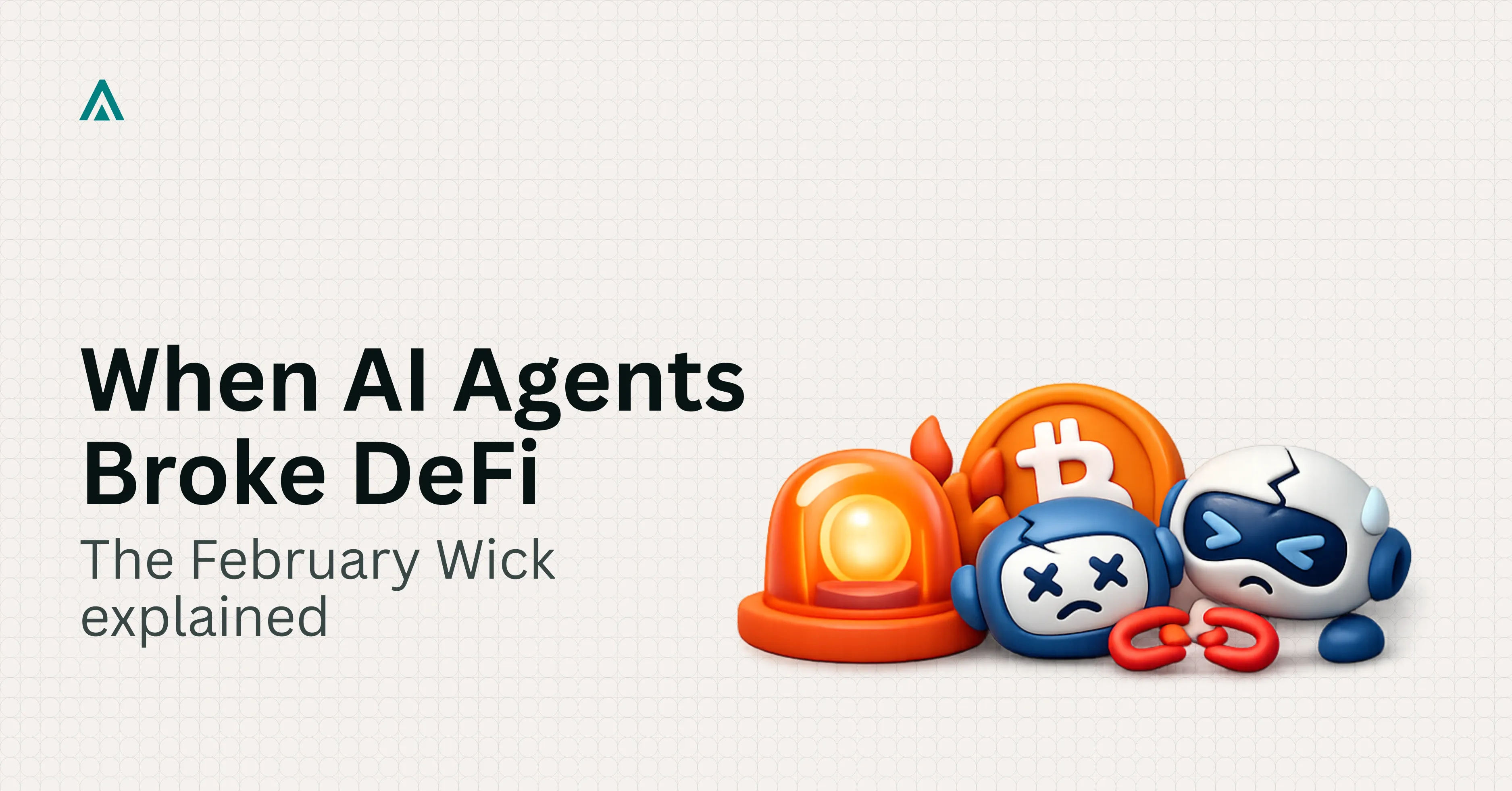
In February 2026, AI agent coordination failure triggered a DeFi liquidation cascade. Audit your protocol: what caused it and three architectural fixes.
Frequently Asked Questions
- In February 2026, a significant DeFi liquidation cascade occurred when thousands of AI agents trained on the same data feeds received identical sell signals following a Bitcoin price drop. Their simultaneous exits amplified the move well beyond what fundamentals alone would produce. This phenomenon is called algorithmic resonance: coordinated behavior emerging from shared training without any direct communication between agents.
- Algorithmic resonance occurs when multiple AI agents trained on the same data respond identically to the same market trigger, amplifying rather than distributing price impact. NBER research published in April 2025 shows AI systems using reinforcement learning can autonomously sustain collusive supra-competitive behavior without any explicit coordination, communication, or intent. In DeFi, this means thousands of agent wallets exit simultaneously, producing a cascade no single agent intended.
- By Q1 2026, Solana had become the dominant chain for autonomous agent payments, accounting for the majority of agentic transactions through the x402 protocol according to Messari. The Virtuals Protocol ecosystem alone completed millions of autonomous agent jobs in a single month by early 2026. The Solana Foundation projects that agents, bots, and LLM-based wallets will drive nearly all on-chain transactions within two years. Agent density is growing faster than protocol-level risk controls are being deployed.
- Yes. Three architectural changes reduce coordinated exit risk without restricting agent activity: diversifying agent training data sources so agents do not all fire on the same trigger; implementing on-chain circuit breakers that rate-limit outflows by velocity rather than price alone; and assigning each agent an independent identity and permission scope using EIP-7702 session key architecture. None of these require removing AI agents from protocol operations.
- The mechanism is not new. The 2010 Flash Crash demonstrated algorithmic resonance in traditional equity markets. DeFi amplifies it because there are no built-in circuit breakers by default, markets operate 24 hours a day, and on-chain transparency lets agents read each other positions in real time. The result is a cascade that is faster and harder to interrupt than anything seen in traditional markets.
Don't Miss What's Next
Subscribe to newsletter
Tags:
February Wick 2026
AI agent coordination failure
algorithmic resonance DeFi
AI agents liquidity crisis
DeFi flash crash 2026
DeFi
Get in Touch
Our team will get back to you within 24 hours.