Spot vs Perps DEX: Capital Flows and Fee Revenue in 2024
Table of Contents
Table of Contents
Share
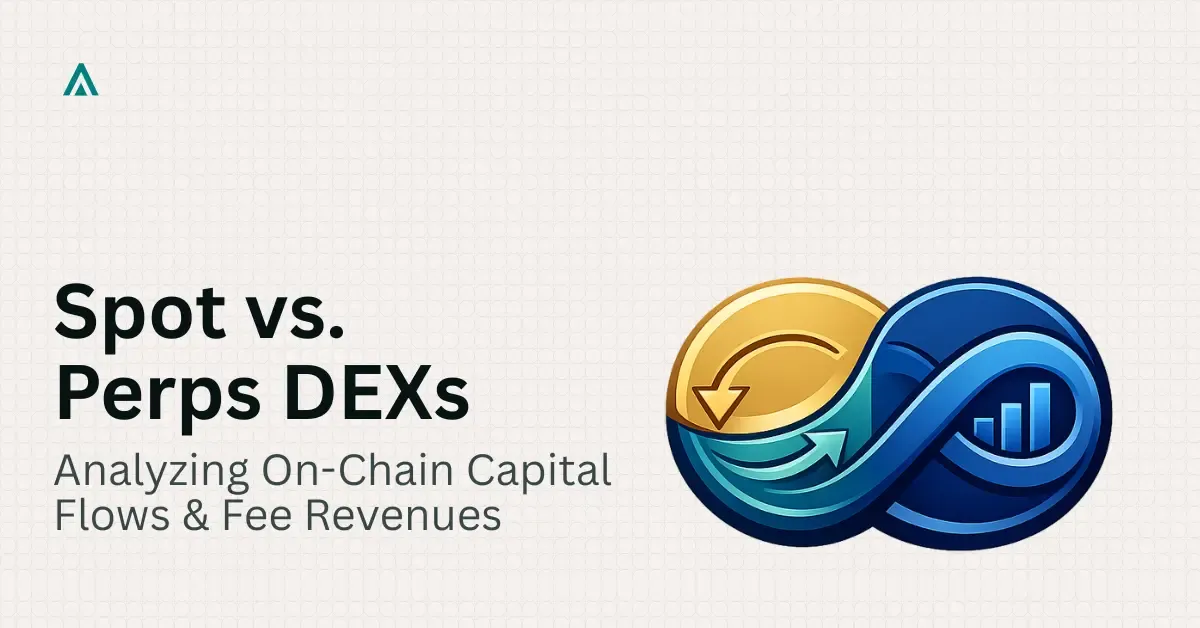
Compare spot and perpetual DEX capital flows in 2024: assess fee revenue models using GMX V2 and dYdX v4 on-chain data before allocating capital with Ancilar.
Frequently Asked Questions
- A spot DEX such as Uniswap settles the actual asset through an automated market maker pool and pays liquidity providers a fee tier of up to 1 percent per trade. A perpetual DEX such as dYdX or GMX lets a trader hold amplified exposure to an asset without owning it, funded by a matching engine or isolated pool that earns funding payments and open interest fees instead of spot trading fees.
- Spot DEXs generate revenue from swap fees tied directly to trading volume, while perpetual DEXs earn from funding rates, open interest fees, and liquidations, income streams that scale with margin activity rather than raw volume. Neither model is uniformly larger; the split depends on market volatility, margin demand, and which venue traders prefer for price discovery versus directional bets.
- Perpetual DEX infrastructure carries additional risk layers beyond standard AMM smart contract exposure, including oracle-dependent liquidation engines, funding-rate manipulation, and margin-driven cascading liquidations during volatility spikes. Spot DEX capital faces impermanent loss and smart contract risk but no liquidation cascade risk, making the two models different risk profiles rather than a simple safer-versus-riskier ranking.
Don't Miss What's Next
Subscribe to newsletter
Tags:
Spot DEX
Perpetual DEX
Capital Flows
DeFi Investment Brief
DeFi
Get in Touch
Our team will get back to you within 24 hours.