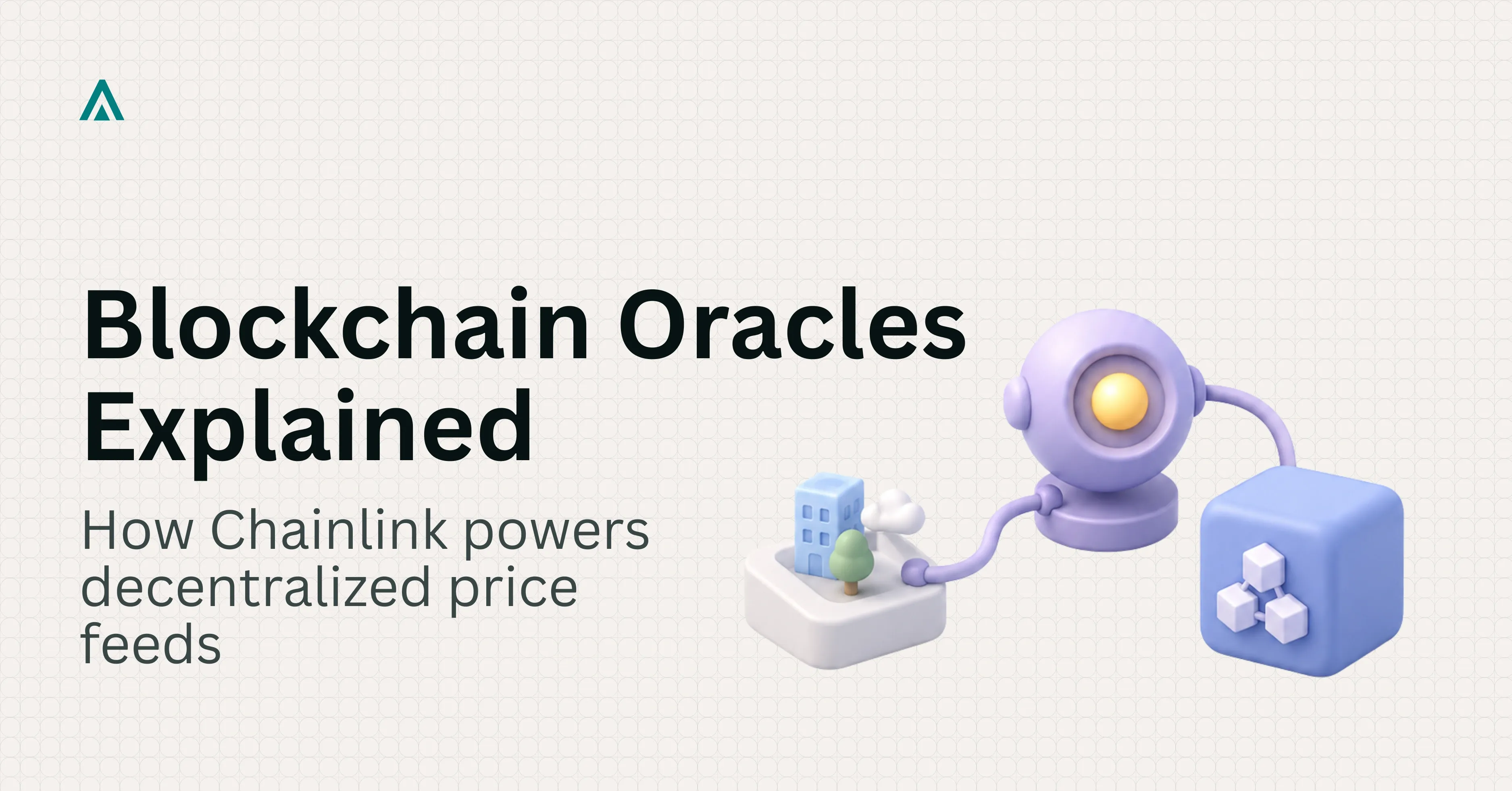
Blockchain Oracles Explained: Chainlink Data Feeds Guide
Table of Contents
Table of Contents
Share
Audit and secure your oracle layer: how Chainlink CCIP and Data Streams solve the Oracle Problem and protect DeFi protocols from manipulation in 2025.
Frequently Asked Questions
- Blockchains are deterministic, closed systems that cannot natively access external data such as asset prices, weather events, or flight statuses. The Oracle Problem is the challenge of introducing off-chain data onto the chain without adding a centralized point of failure or creating a trust dependency that undermines the protocol's security guarantees.
- Chainlink operates a Decentralized Oracle Network where independent node operators each retrieve data from multiple premium sources, including Binance, Coinbase, and Kraken. The nodes reach off-chain consensus via a median aggregation mechanism before submitting a single signed value to the smart contract, removing any single point of manipulation.
- Oracle manipulation is an attack where an adversary artificially moves the reported price of an asset on a low-liquidity source so that a dependent smart contract executes on false data. Protocols prevent it by combining Time-Weighted Average Prices (TWAP), multi-source aggregation across high-liquidity venues, on-chain circuit breakers that pause actions on anomalous price deltas, and Proof of Reserve attestations for tokenized assets.
- Chainlink CCIP (Cross-Chain Interoperability Protocol) is a messaging and token transfer standard that lets smart contracts on one chain send data or value to contracts on a different chain in a single atomic operation. It includes an independent Risk Management Network that monitors for anomalous activity. Use CCIP when building cross-chain DeFi, multi-chain tokenized assets, or enterprise integrations that require chain-agnostic data delivery.
- Oracle-dependent DeFi protocols serving EU users must consider MiCA Regulation EU 2023/1114, which under Article 76 requires asset-referenced token issuers to maintain reliable and auditable price references. The Digital Operational Resilience Act (DORA) Regulation EU 2022/2554 Article 9 mandates ICT risk management controls, which in practice requires redundant oracle feeds and documented failover procedures for regulated entities relying on third-party data providers.
Don't Miss What's Next
Subscribe to newsletter
Tags:
Oracle
Chainlink
DeFi Security
CCIP
RWA
DeFi
Get in Touch
Our team will get back to you within 24 hours.