On-Chain Agents: x402, ERC-6551 and Intent Stack 2026
Table of Contents
Table of Contents
Share
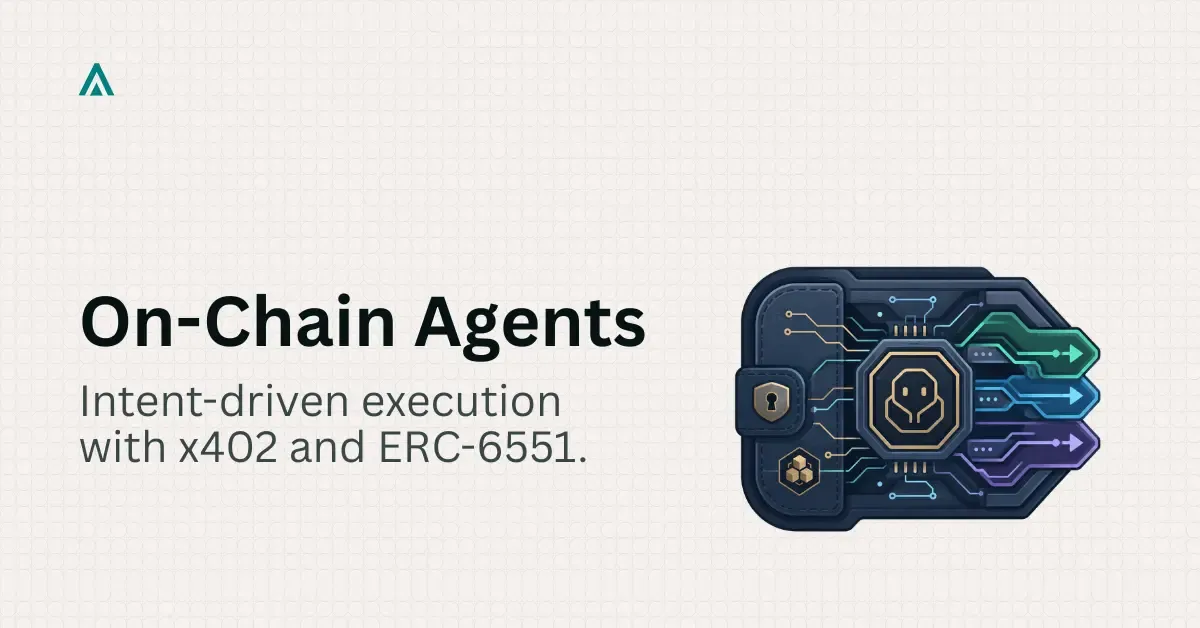
How x402, ERC-6551, ERC-8004 and intent protocols rebuild the agent stack for autonomous on-chain execution and bounded spend, a 2026 architecture guide.
Frequently Asked Questions
- A chatbot returns text and calls APIs through credentials a human holds, so it cannot hold value or settle anything by itself. An on-chain agent holds a smart account, signs its own transactions, pays for resources over x402, and settles outcomes on a ledger. The agent becomes an economic actor with verifiable identity, a budget, and a transaction history rather than a stateless text generator.
- ERC-6551 binds a smart account to an NFT, so the agent identity becomes a transferable token with a deterministic account address computed from chain ID, token contract, token ID, and salt. You can transfer the whole agent, including its assets and history, by transferring one NFT. A normal externally owned account has no portable identity, no nested ownership, and no clean handoff path between operators.
- The four dominant failure modes are key compromise leading to fund drain, unbounded spend from a buggy policy or prompt injection, solver or counterparty manipulation of intent execution, and stale validation where reputation data lags real behavior. Each is mitigated by a different layer: session keys with scoped permissions, on-chain spend caps and circuit breakers, intent constraints with minimum output guarantees, and fresh signed validation records.
Don't Miss What's Next
Subscribe to newsletter
Tags:
AI Agents
Account Abstraction
Web3 Architecture
Get in Touch
Our team will get back to you within 24 hours.