DeFi Composability: Integration and Circuit Breaker Design
Table of Contents
Table of Contents
Share
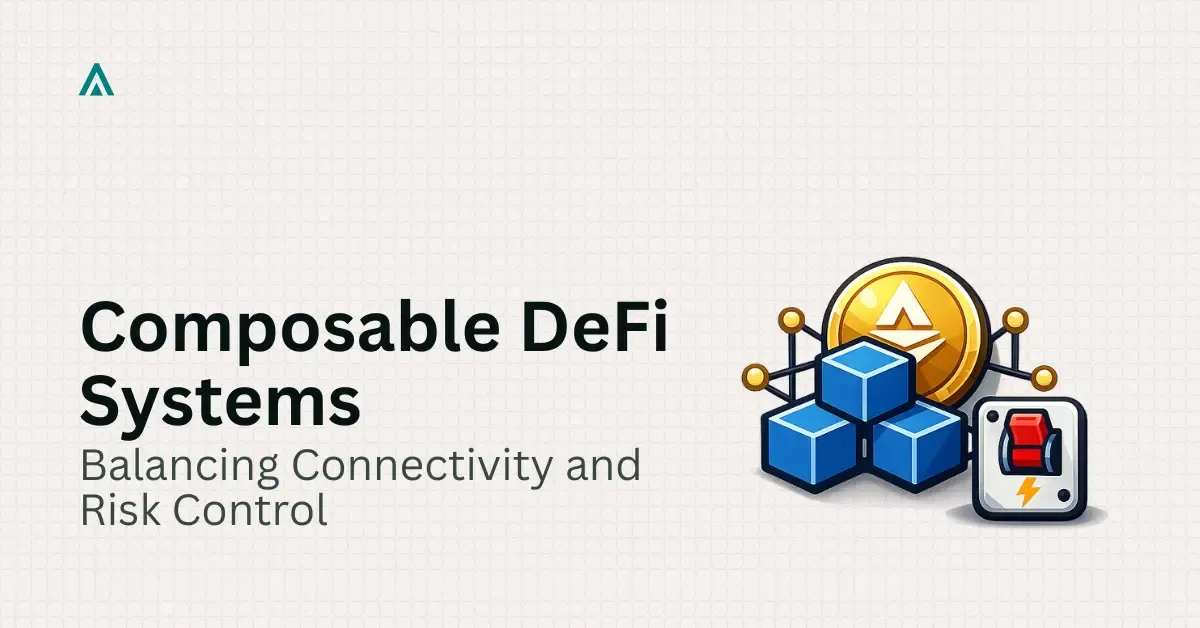
DeFi composability engineering, January 2024: integration patterns, dependency-risk isolation, and circuit-breaker design for production protocol architecture.
Frequently Asked Questions
- From an engineering standpoint, DeFi composability means one smart contract calls another within a single atomic transaction, so the entire sequence either succeeds or reverts together. A protocol reads a price from an oracle contract, pulls liquidity from an automated market maker, or deposits collateral into a lending pool, all through external contract calls. The benefit is that developers build on existing primitives instead of reimplementing them. The cost is that each external call is a trust boundary: the calling contract inherits the correctness, liveness, and security assumptions of every contract it touches, and a failure in any one of them can propagate atomically into the caller.
- A circuit breaker is an on-chain control that halts or limits a protocol's sensitive functions when a monitored condition crosses a defined threshold. Typical triggers include an oracle price that deviates beyond a tolerance band, a withdrawal rate that exceeds a per-block or per-period cap, or a dependency that returns stale data. When tripped, the breaker pauses the affected functions, rejects the abnormal call, or caps the flow, giving the protocol time to react rather than propagating a dependency failure. Well-designed breakers fail closed on the risky path while keeping unaffected functions live, and they expose a clear recovery procedure governed by the protocol's access control.
- Dependency risk is isolated by treating every external contract call as an untrusted boundary and wrapping it in validation. Concrete techniques include validating oracle freshness and deviation before using a price, using staticcall for read-only queries that must not mutate state, checking return data length and success flags on low-level calls, applying the checks-effects-interactions order to prevent reentrancy across the boundary, and placing per-dependency circuit breakers that trip when a specific dependency misbehaves. The goal is that a failure in one dependency degrades only the functions that use it, rather than cascading through the whole protocol.
Don't Miss What's Next
Subscribe to newsletter
Tags:
DeFi Composability
Circuit Breaker
Smart Contract Security
Get in Touch
Our team will get back to you within 24 hours.