Chainlink vs TWAP Oracles: Architecture and Integration
Table of Contents
Table of Contents
Share
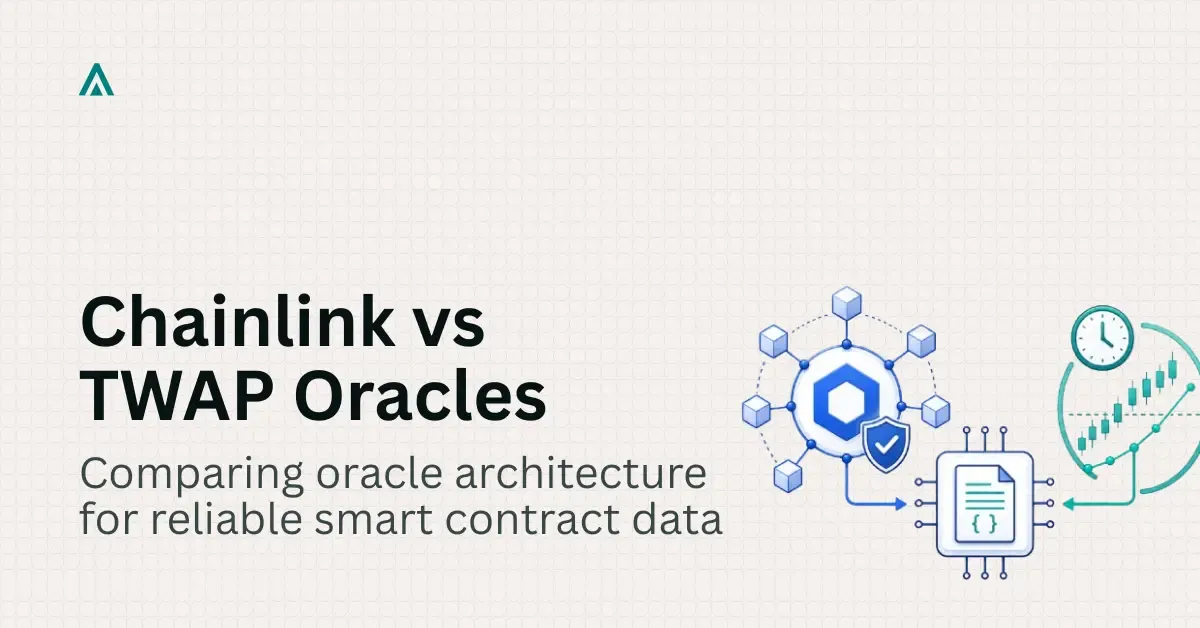
Chainlink vs Uniswap V3 TWAP: 30-minute TWAP window is the production baseline. Build hybrid DeFi oracle integrations with deviation guards and Foundry tests.
Frequently Asked Questions
- Chainlink uses a push model where off-chain node operators aggregate exchange prices and submit signed updates on-chain when a heartbeat interval expires or a deviation threshold is crossed. Uniswap V3 TWAP uses a pull model where any consumer contract computes a time-weighted average price from on-chain pool tick observations. Chainlink covers more asset pairs with lower latency; TWAP covers any pair with a Uniswap V3 pool at the cost of secondary-market depth dependency.
- Chainlink push feeds are more manipulation-resistant for major assets because the aggregated off-chain price cannot be moved by a single on-chain transaction. Uniswap V3 TWAP becomes manipulation-resistant only above a minimum time window (typically 30 minutes) and a minimum underlying pool depth. For lending protocols, Chainlink is the default; TWAP is the fallback for long-tail assets without Chainlink coverage.
- Production protocols read Chainlink as the primary price source, read Uniswap V3 TWAP as a sanity-check fallback, and revert when the two diverge above a configured threshold (typically 2 to 5 percent). The deviation guard catches both stale Chainlink feeds and TWAP manipulation attempts. The configuration is per-asset because long-tail assets need wider thresholds than major pairs.
Don't Miss What's Next
Subscribe to newsletter
Tags:
Chainlink
TWAP
oracles
DeFi security
integration
2024
DeFi
Get in Touch
Our team will get back to you within 24 hours.