Sovereign AI Infrastructure: On-Chain Compute Replaces Cloud
Table of Contents
Table of Contents
Share
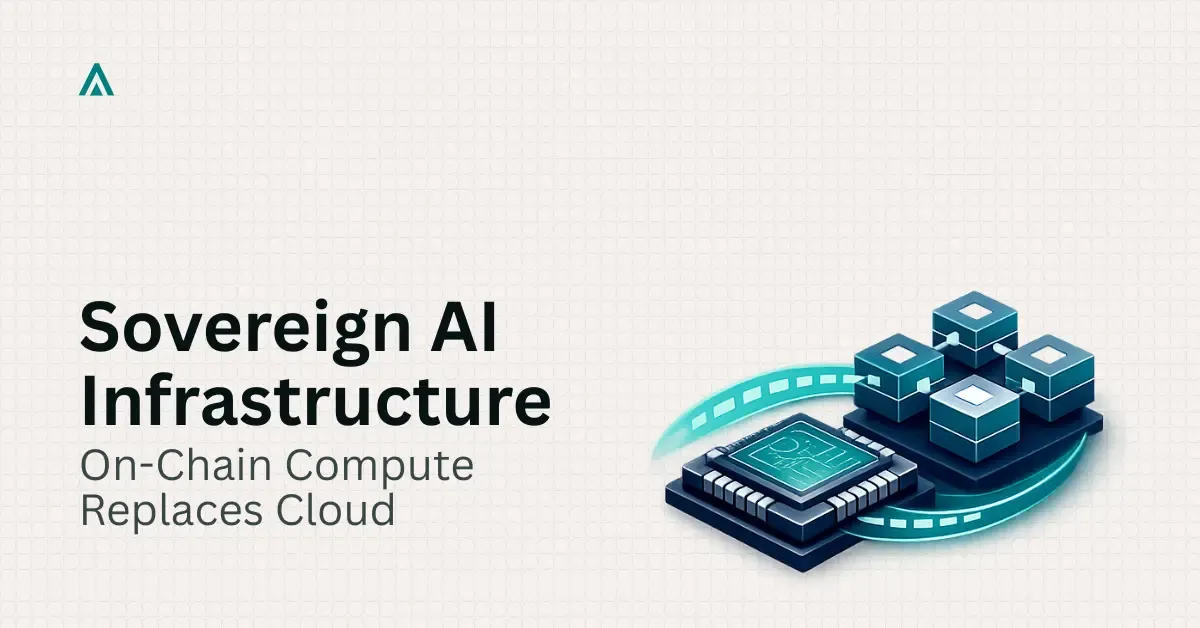
Why sovereign AI infrastructure and on-chain compute markets are replacing cloud in Web3 in 2026: DePIN GPU supply, capital allocator signals, and a build path.
Frequently Asked Questions
- Sovereign AI infrastructure is compute, data, and model capacity that a nation, institution, or enterprise controls directly rather than renting from a foreign hyperscale cloud. In a Web3 context it pairs with on-chain compute markets, where GPU supply is coordinated, priced, and settled through a public ledger instead of a single provider's billing system. The goal is jurisdictional control over where AI workloads run and who can revoke access.
- A traditional cloud provider owns the data centers, sets the price, and can suspend an account unilaterally. An on-chain compute market is a coordination layer that aggregates GPU supply from many independent operators, prices it through open bidding, and settles payment and proof of work on a public ledger. The result is a competitive spot market for compute with no single point of control, though it trades the cloud's integrated tooling for lower cost and censorship resistance.
- For latency-sensitive production inference tied to enterprise data, integrated cloud remains the safer default in 2026. On-chain compute markets are most compelling for batch training, fine-tuning, and rendering, where cost savings are large and jurisdictional control matters. Most institutions begin with a hybrid posture, routing price-elastic batch work to decentralized GPU markets while keeping regulated, low-latency workloads on owned or sovereign cloud capacity.
Don't Miss What's Next
Subscribe to newsletter
Tags:
Sovereign AI
DePIN Compute
On-Chain Compute Markets
AI Infrastructure
Web3 Infrastructure
Get in Touch
Our team will get back to you within 24 hours.