Optimistic Rollup Fraud Proof: Architecture and Challenge
Table of Contents
Table of Contents
Share
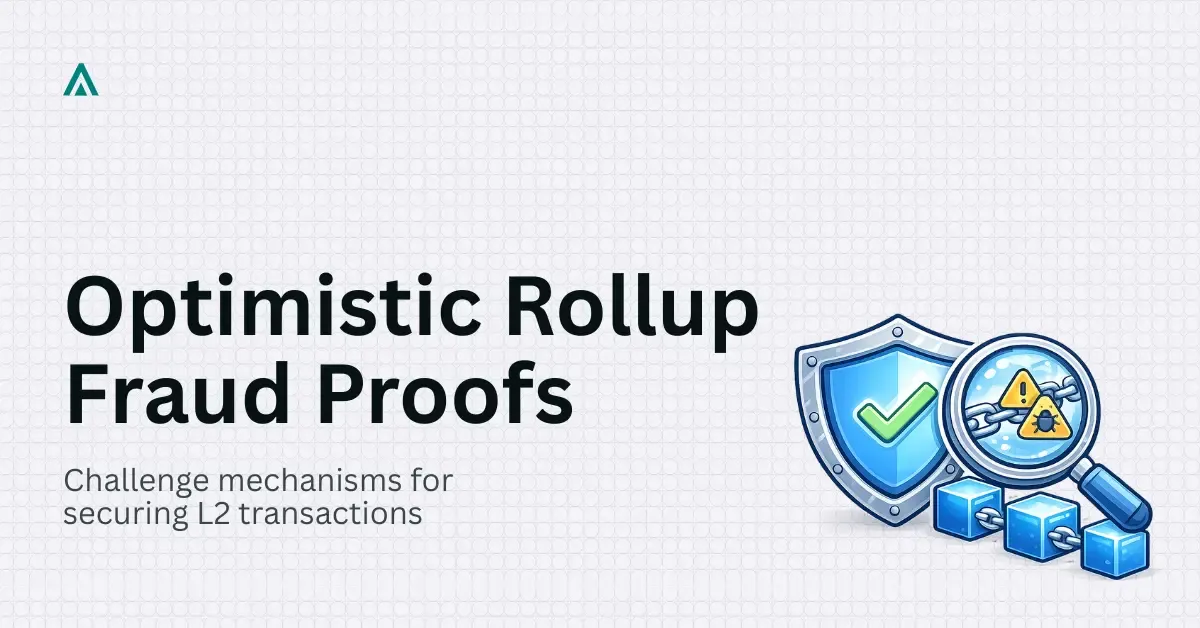
Optimistic rollup state machines: a 2024 engineering deep-dive on fraud proof architecture, interactive challenge design, and the 7-day window for L2 builders.
Frequently Asked Questions
- A fraud proof is an on-chain mechanism that lets a verifier challenge an invalid state transition posted by a rollup sequencer. The rollup assumes posted state roots are correct unless a verifier opens a dispute during the challenge window. The disputed computation is bisected over multiple rounds until a single instruction can be re-executed on L1, which determines who was honest. Arbitrum Nitro proves disputed execution against a Geth client compiled to WASM, and Optimism Bedrock uses the Cannon interactive fault prover for the same purpose.
- Seven days is the design margin Optimism and early Arbitrum chose to absorb worst-case censorship attacks on the underlying Ethereum L1. The window must outlast any plausible reorganisation, network partition, or denial-of-service campaign that could block an honest verifier from posting a challenge transaction. Shorter windows weaken security; longer windows worsen user withdrawal latency. Engineering teams treat seven days as the floor for production rollups in 2024.
- Arbitrum Nitro compiles its execution code twice: once to native code for fast L2 execution, once to WAVM, a restricted WebAssembly dialect, for use in disputes. Disputes bisect WAVM execution until a single instruction can be re-run on L1. Optimism Bedrock pairs op-geth at the execution layer with the Cannon interactive fault prover, which uses a MIPS-based virtual machine for the disputed step. Both follow the same multi-round interactive bisection model with different proving substrates.
Don't Miss What's Next
Subscribe to newsletter
Tags:
Optimistic Rollups
Fraud Proofs
L2 Architecture
Blockchain
Get in Touch
Our team will get back to you within 24 hours.