Layer 2 Scaling: Optimistic vs. ZK Rollups Compared
Table of Contents
Table of Contents
Share
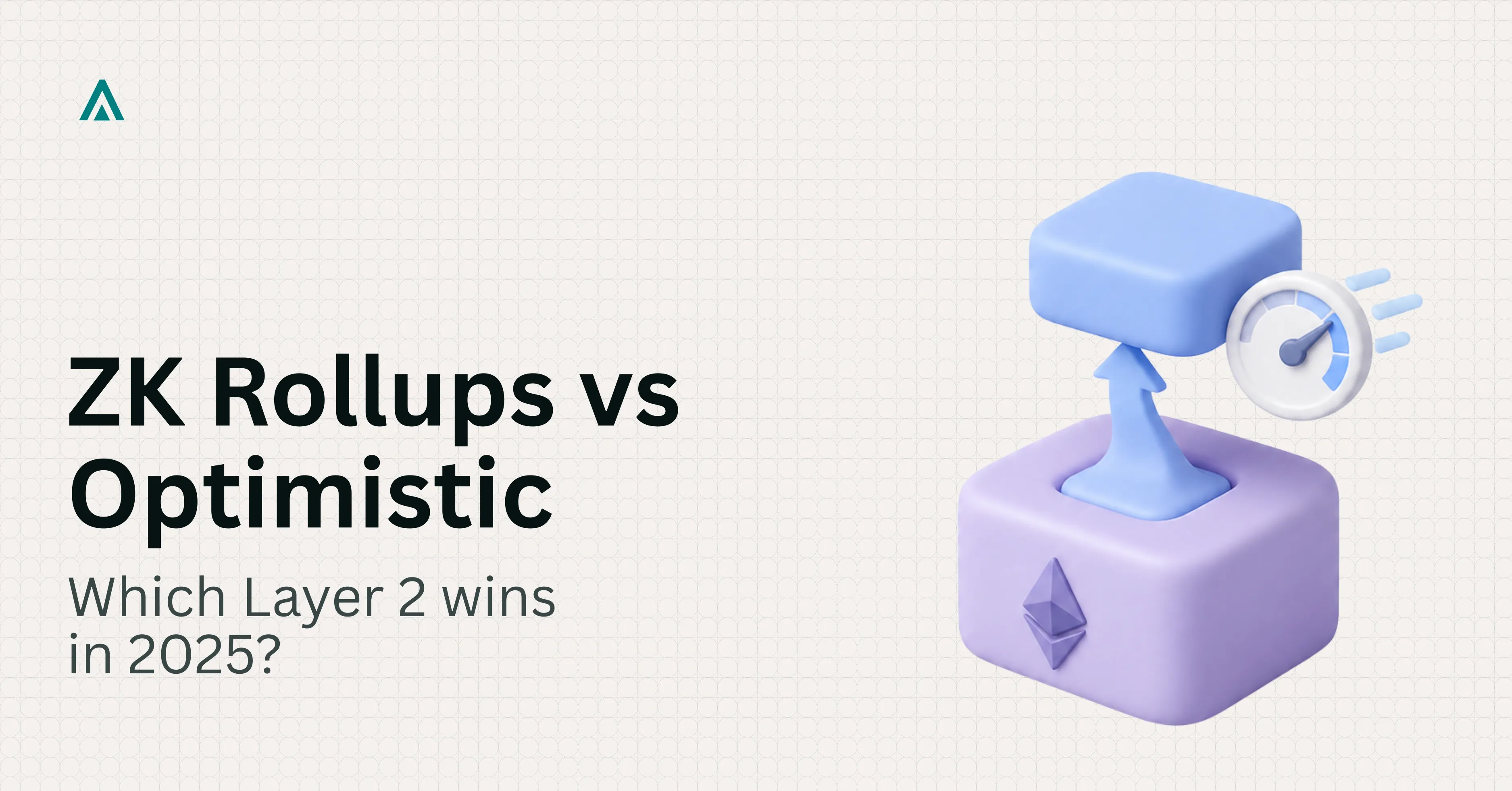
Audit your L2 options: compare Optimistic and ZK-Rollups on finality, capital efficiency, EVM compatibility, and compliance fit for production systems in 2025.
Frequently Asked Questions
- Layer 2 scaling refers to off-chain execution frameworks that batch thousands of transactions and post compressed proofs or state roots to Ethereum L1. The result is throughput measured in thousands of TPS alongside gas costs below one cent per transaction, while inheriting Ethereum's cryptographic security and decentralization guarantees.
- Optimistic Rollups assume all submitted transactions are valid and rely on a 7-day fraud-proof challenge window during which watchers can dispute invalid state transitions. ZK-Rollups generate a cryptographic validity proof (SNARK or STARK) that mathematically certifies every state transition before Ethereum L1 accepts it, delivering finality within minutes and eliminating the capital lock-up of the challenge period.
- ZK-Rollups are the superior choice for regulated financial applications because cryptographic finality satisfies clearing and settlement compliance requirements that demand deterministic, near-instant confirmation. Instant withdrawals eliminate the counterparty dependency of fast-withdrawal liquidity providers, and selective disclosure proofs enable KYC verification without exposing underlying identity data, which aligns with GDPR and MiCA data minimization principles.
- EIP-4844, known as Proto-Danksharding, activated on Ethereum in March 2024. It introduced a dedicated blob data channel for rollup transaction data, separate from calldata, at a fraction of the previous cost. Major rollups reported average transaction fees dropping by up to 10x immediately after activation, making sub-cent per-transaction costs the new production baseline for both Optimistic and ZK-Rollup architectures.
- A modular blockchain separates the four core functions of a blockchain, which are Execution, Settlement, Data Availability, and Consensus, into specialized layers. Layer 2 rollups are the execution layer in this stack. They offload transaction processing from Ethereum L1 and can use dedicated Data Availability layers such as Celestia or EigenDA instead of Ethereum calldata, further reducing cost and enabling application-specific chains known as Layer 3 rollups.
Don't Miss What's Next
Subscribe to newsletter
Tags:
Layer 2 scaling
ZK rollup
Optimistic rollup
EIP-4844
Ethereum L2
zkEVM
rollup architecture
Blockchain
Get in Touch
Our team will get back to you within 24 hours.