Fine-Tune Llama 3.3 70B for Hotel Revenue Management
Table of Contents
Table of Contents
Share
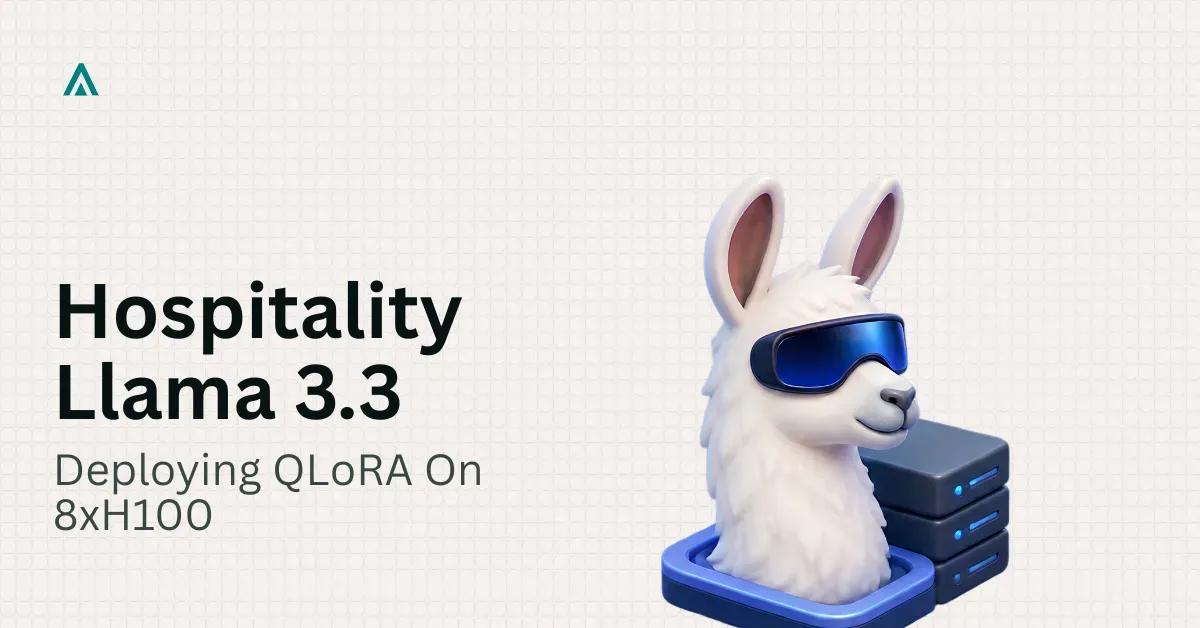
Fine-tune Llama 3.3 70B with QLoRA on 8xH100 for the $4.3B hotel revenue management market: cut GPU spend, boost rate accuracy, and audit build costs first.
Frequently Asked Questions
- QLoRA freezes the base model in 4-bit NormalFloat precision and trains small adapter matrices on top, which lets a 65B-class model fine-tune on a single 48GB GPU while matching full 16-bit fine-tuning performance. For a 70B model like Llama 3.3, that means an 8xH100 node has spare headroom for larger batch sizes and faster iteration instead of needing a second node.
- Yes. Most hotel groups pilot QLoRA on an 8B or 13B checkpoint against one property's booking and rate history first, validate the rate-recommendation accuracy gain, then scale the same pipeline to 70B once the business case is proven. This keeps first-pilot GPU cost low and de-risks the larger training run.
- An audit covers training data lineage, adapter version control, evaluation methodology against held-out booking windows, and a review of the guardrail layer that caps rate swings before they reach the property management system. Ancilar scopes this as a fixed deliverable alongside the fine-tuning build.
- No. A fine-tuned model generates rate and demand narratives and recommendations that feed into the existing pricing engine and property management system, it does not replace the transactional pricing engine itself or remove the revenue manager's final approval on rate changes.
Don't Miss What's Next
Subscribe to newsletter
Tags:
Fine-Tuning
Hospitality
Revenue Management
QLoRA
Llama 3.3
Blockchain
Get in Touch
Our team will get back to you within 24 hours.