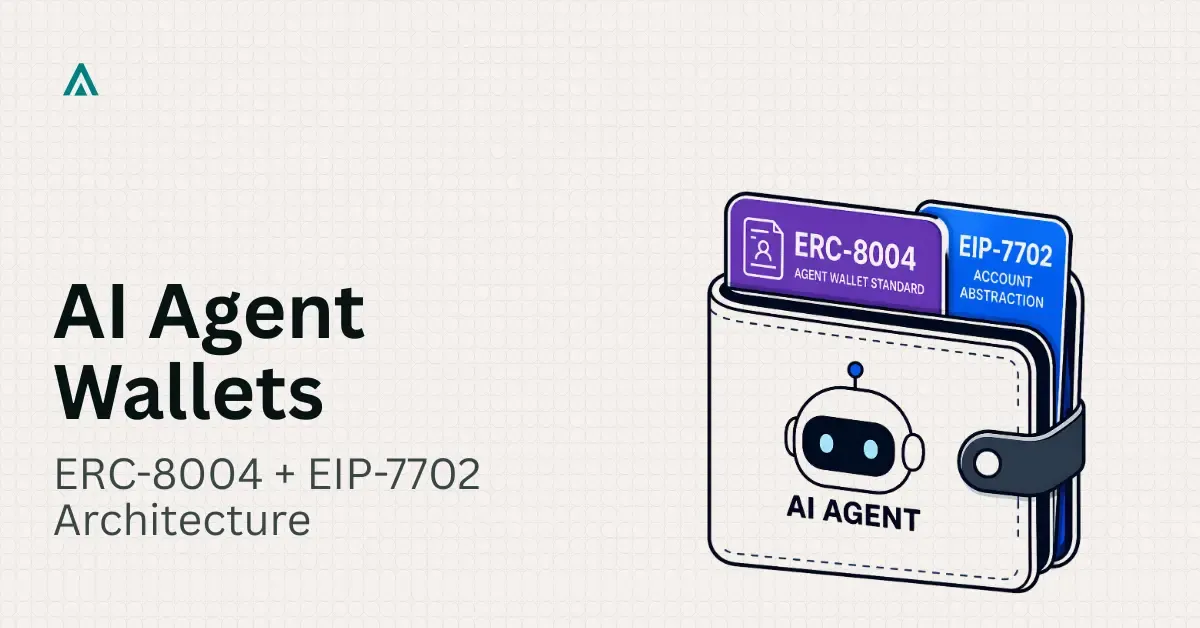
AI Agent Wallet: ERC-4337 + EIP-7702 Architecture Guide
Table of Contents
Table of Contents
Share
Build production AI agent wallets in 2026: ERC-4337 vs MPC tradeoffs, EIP-7702 session keys, on-chain spending policies, and vendor comparison for CTOs.
Frequently Asked Questions
- Standard smart wallets are optimized for human signing UX, recovery flows, and manual confirmation steps. AI agent wallets are designed for autonomous, programmatic operation: they include on-chain spending policies enforced at the contract level, session-scoped keys with hard expiry dates, gas sponsorship via paymasters so agents never need to hold ETH, and API-accessible signing. The architecture difference matters because an agent that signs with an unrestricted EOA has zero on-chain guardrails against a malicious prompt injection or corrupted API response draining the wallet balance.
- No. ERC-4337 requires a shared EntryPoint contract deployed on each target chain, making it EVM-native. For non-EVM chains such as Solana, Cosmos, or Bitcoin, you need an MPC wallet layer or a cross-chain abstraction protocol. For multi-chain EVM deployments across Ethereum, Base, Arbitrum, Optimism, and Polygon, the same EntryPoint address is used across all chains, so there is no per-chain configuration overhead once the smart account is deployed.
- ERC-4337 creates a new smart contract wallet with a fresh address and a full on-chain policy engine. EIP-7702 upgrades an existing EOA in place: the EOA signs one delegation transaction pointing to a smart wallet implementation contract, gaining session keys, spending caps, and gas sponsorship without changing its address or migrating assets. EIP-7702 shipped in the Ethereum Pectra upgrade on May 7, 2025, and is production-stable for existing EOA upgrades. For new agent deployments starting from scratch, ERC-4337 smart accounts offer a more mature feature set.
- Three controls work together. First, session keys with strict per-session allowances and hard expiry dates limit the blast radius to the session window regardless of what the agent does. Second, on-chain spending caps implemented in the smart account's validateUserOp function enforce per-transaction and daily limits at the contract level, not solely in application code. Third, an MPC signing threshold for high-value operations requires multi-party approval before large transfers execute. None of these controls alone is sufficient. Crypto losses reached 1.74 billion USD through April 2025, with CeFi private key compromises accounting for 94% of that figure. All three layers together restrict a compromised agent to its session-defined permission set.
- Coinbase AgentKit is the fastest path to a working agent wallet for teams building on Base, with native x402 payment protocol support and pre-built DeFi action SDKs. Openfort is the right choice for teams that need full architectural control with no vendor lock-in and can invest the engineering time that openness requires. Turnkey suits compliance-sensitive deployments where private key custody provenance must be hardware-attested and audit-ready. Dynamic, now part of Fireblocks, fits enterprise treasury agents where institutional custody grade and audit trails are hard requirements. The 2025-2026 acquisition wave means the vendor decision now includes evaluating the parent company roadmap, not only the SDK.
Don't Miss What's Next
Subscribe to newsletter
Tags:
ERC-4337
EIP-7702
AI agent wallet
agentic wallet architecture
account abstraction
AI-Web3
Get in Touch
Our team will get back to you within 24 hours.