Building FiduWork's Freelance Marketplace and Payment Workflows
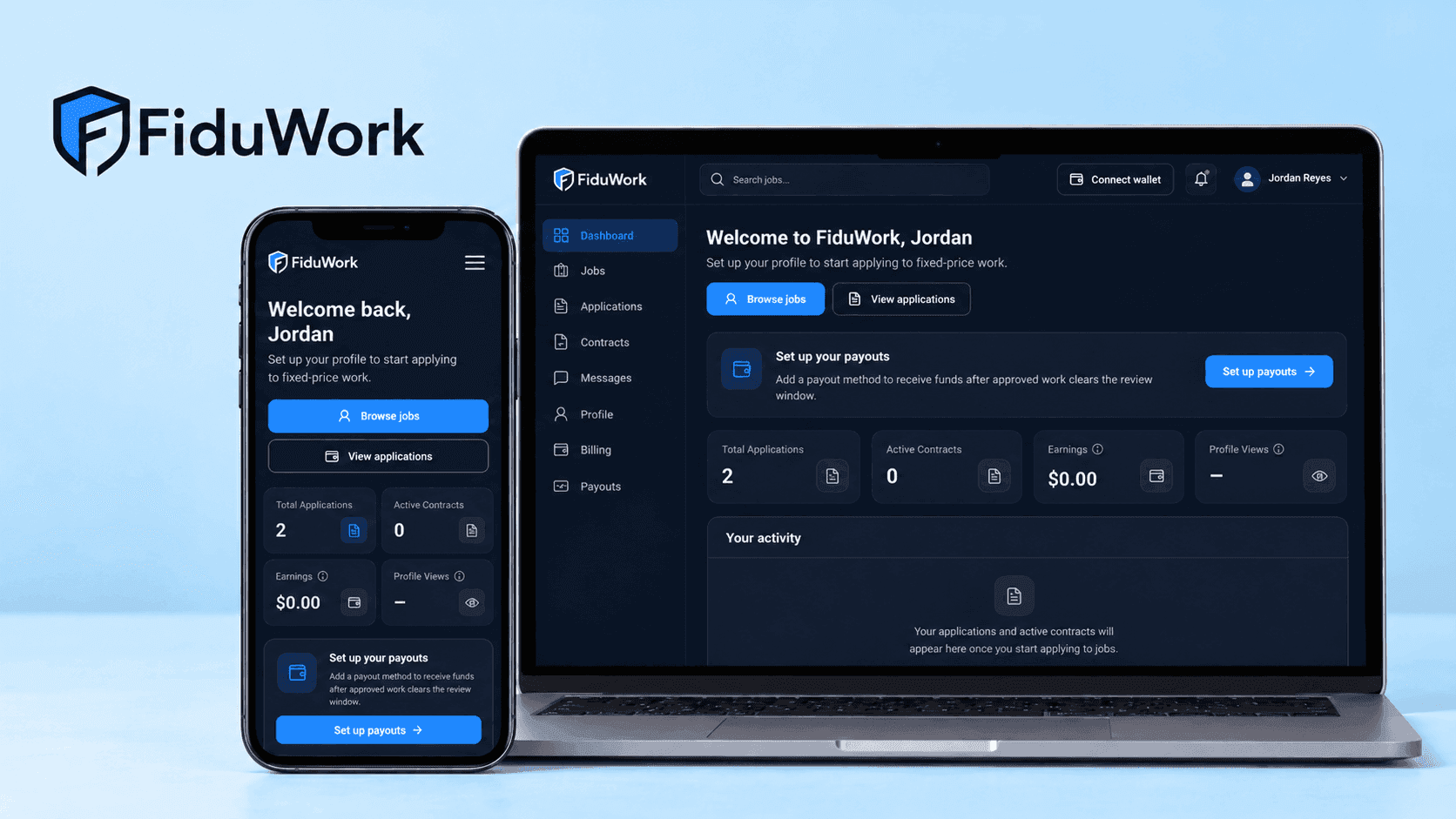
Ancilar built FiduWork's web platform, backend services and payment workflows for fixed-price freelance hiring. The beta combines Stripe card payments with a USDC escrow workflow on the Sepolia test network, supported by review, dispute and administration tools.
- Team Size
- 4
- Payment Options
- 2
- Crypto on Sepolia Testnet
- Beta
Technical Implementation
Execution Summary
A four-person team connected hiring, funding, work review and settlement in one application, with distinct payment integrations and operational tools for managing contracts and disputes.
- 01
One Hiring Workflow
Clients post, hire, fund and review on the same contract page, whichever payment option the job uses.
- 02
Stripe Payments and Payouts
Card payments through Stripe Checkout and freelancer payouts through Stripe Connect Express, with each payment, refund and transfer linked on the contract.
- 03
USDC Escrow on Sepolia
Each crypto contract gets its own escrow contract, with stakes from both parties and a 7-day review window after submission.
- 04
Juror-Panel Disputes
Crypto disputes go to a panel of staked jurors. A split panel resolves to a client refund, and a missed quorum goes to the dispute admin.
Tech Stack:
 PostgreSQL
 Solidity
 React
 NextJs
 Web3 Wallet
 Hardhat
 Node.js
 TypeScript
 wagmi
 Tailwind CSSPostgreSQLSolidityReactNextJsWeb3 WalletHardhatNode.jsTypeScriptwagmiTailwind CSSPostgreSQLSolidityReactNextJsWeb3 WalletHardhatNode.jsTypeScriptwagmiTailwind CSS
FAQ
Frequently Asked Questions
The web platform for clients, freelancers, jurors and admins, the backend services behind it, the Stripe payment and payout integration, and the USDC escrow and dispute workflow.
FiduWork is in beta. Card payments use Stripe, and the USDC option runs on the Sepolia test network with test USDC.
No. Stripe handles card payments and freelancer payouts. The escrow option is the USDC smart-contract workflow on Sepolia.
It keeps each job's funds separate, and a platform service handles deployment so users only sign the steps that move their own funds.
On card jobs, FiduWork admins decide. On crypto jobs, a panel of staked jurors votes. A split panel resolves to a client refund. If quorum is not reached, the dispute admin resolves the case.



A clear proven process, that delivers
End of Scroll. Start of Discovery.
You've seen our ideas - now go deeper.
Discover more insights, guides, and engineering practice.