Why I No Longer Trust Centralized Exchanges: A DeFi Guide
Table of Contents
Table of Contents
Share
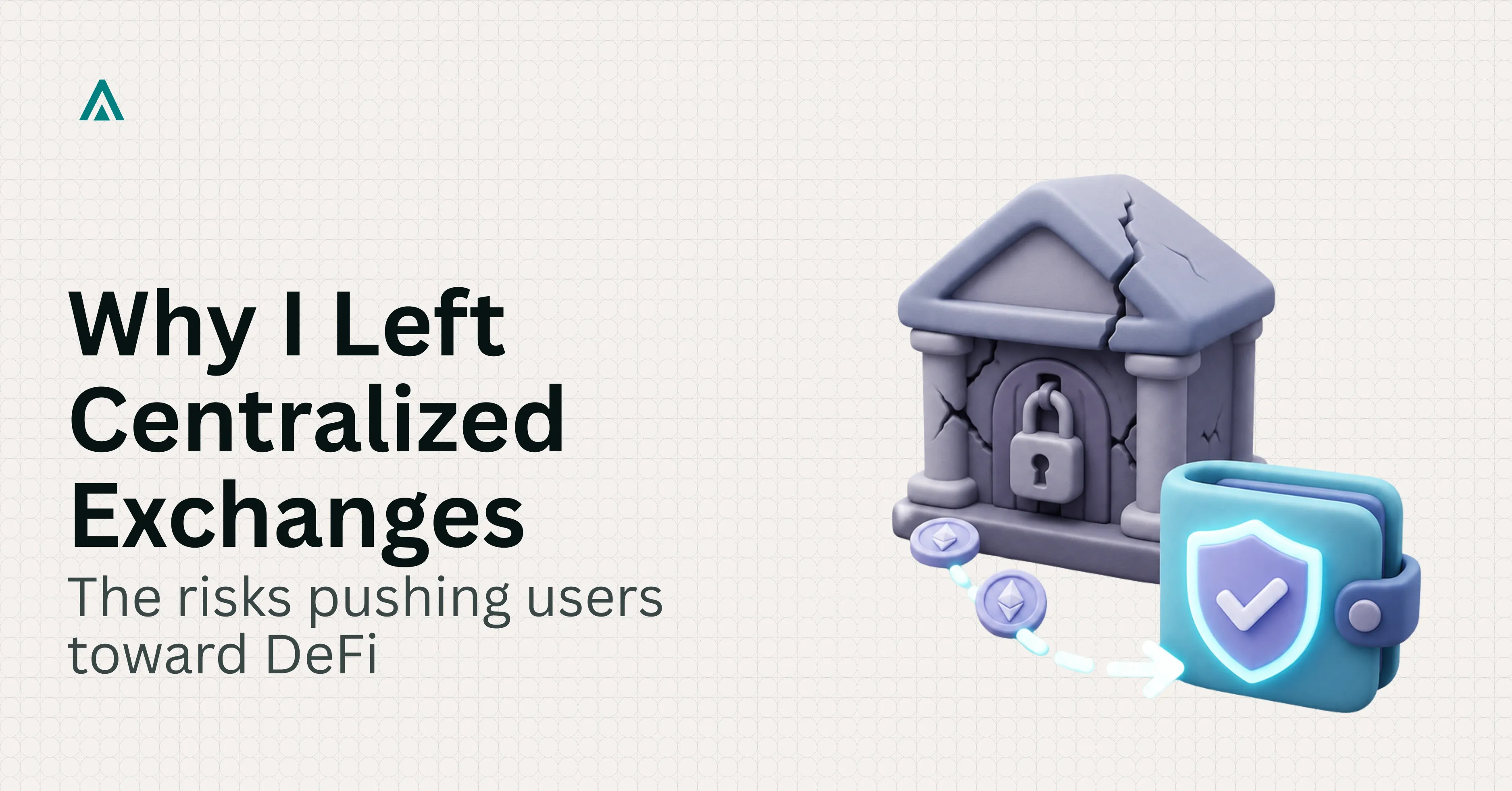
Centralized exchanges fail founders when it matters: $8B lost in FTX. Build a secure DeFi treasury with DEXs, AMMs, and StableSwaps. Practical 2025 guide.
Frequently Asked Questions
- A decentralized exchange is a protocol that allows peer-to-peer token trading directly from a self-custody wallet, using smart contracts instead of a central order book or custodian. Users retain full control of their private keys throughout every trade.
- AMMs use the constant-product formula x multiplied by y equals k, where x and y are the token reserves in a liquidity pool. As traders buy one token, its reserve shrinks and its price rises automatically without any order book or counterparty matching.
- Impermanent loss occurs when the price ratio of two pooled assets diverges after deposit. The AMM rebalances the reserves, which means a liquidity provider holds fewer of the appreciating token relative to holding both assets outright. The loss is unrealised until withdrawal if the ratio has not recovered.
- StableSwap protocols like Curve Finance use a hybrid invariant combining a constant-sum curve with a constant-product curve. Near the peg, the curve is nearly flat, so large stablecoin trades move the price very little, producing slippage under 0.1 percent on multi-million-dollar swaps.
- Founders should use centralised exchanges only for fiat on-ramp and off-ramp. For treasury swaps, yield generation, and cross-chain moves, DeFi protocols give custody-retained settlement with on-chain auditability. Centralised platforms introduce counterparty risk and withdrawal freeze risk that is unacceptable for business-critical operations.
Don't Miss What's Next
Subscribe to newsletter
Tags:
Centralized Exchanges
DeFi Tools
Decentralized Exchanges
Automated Market Makers
StableSwaps
DeFi
Get in Touch
Our team will get back to you within 24 hours.