MCP vs A2A: AI Agent Protocol Differences Explained
Table of Contents
Table of Contents
Share
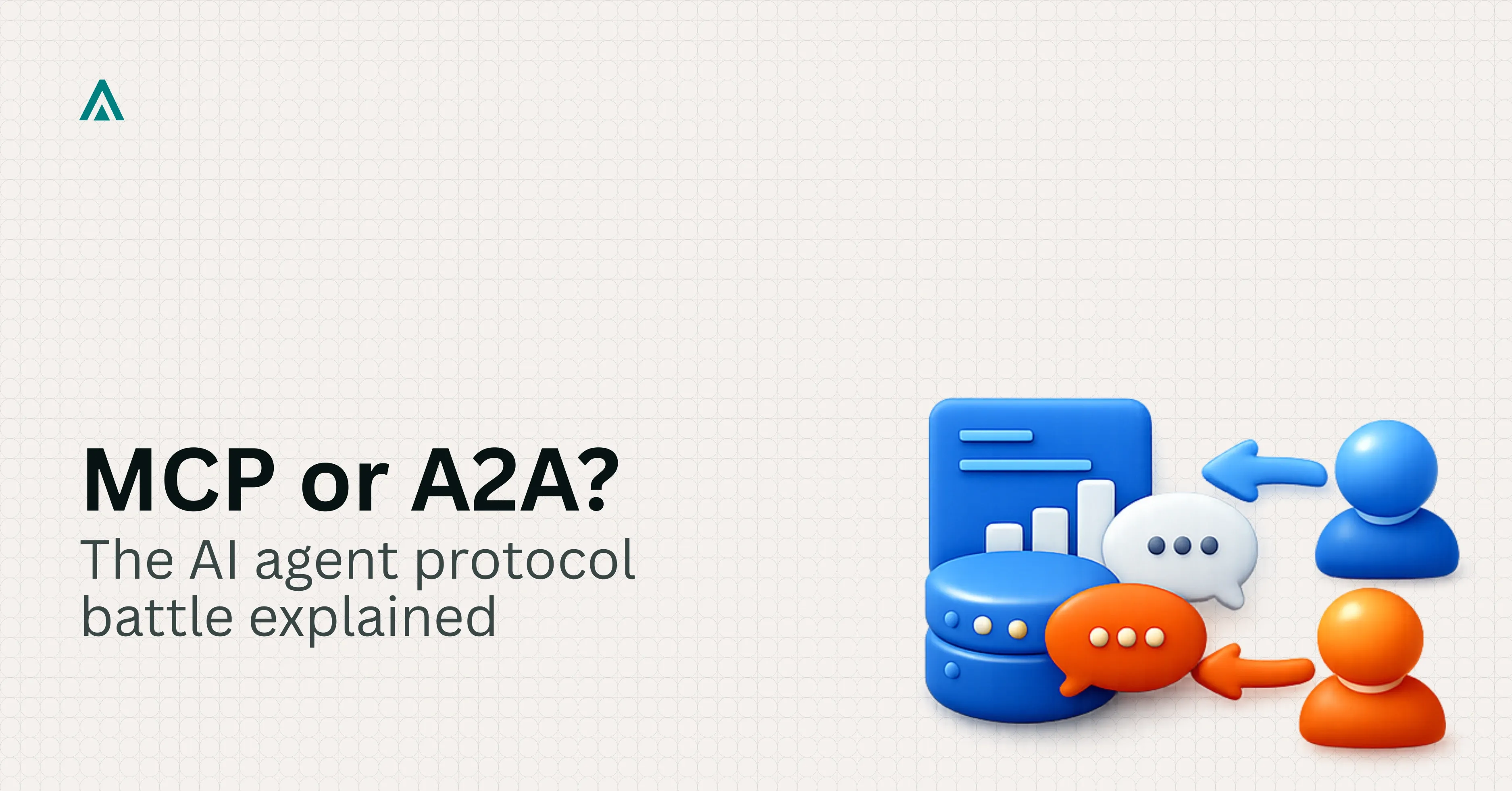
MCP has 97M monthly SDK downloads. A2A launched with 50+ partners in April 2025. Technical breakdown of both protocols and how Web3 builders deploy them.
Frequently Asked Questions
- MCP and A2A solve different problems. MCP handles agent-to-tool connections such as databases, APIs, and file systems, and is production-ready as of early 2026 with 97 million monthly SDK downloads. A2A handles agent-to-agent coordination for multi-agent workflows and is still in pre-production stages. Most teams start with MCP for tool access and layer in A2A as their orchestration needs grow.
- Yes, that is the intended design. MCP gives each agent vertical connectivity to tools and data sources. A2A gives agents horizontal coordination capabilities to discover, delegate to, and receive results from other agents. Google runs both in production: MCP inside Gemini for tool access, A2A for inter-agent workflows. They operate at different layers of the same stack.
- The Linux Foundation governs both protocols as of late 2025 to early 2026. MCP lives inside the Agentic AI Foundation, co-founded by Anthropic, OpenAI, Google, Microsoft, and AWS, with the donation completed in December 2025. A2A was transferred to its own Linux Foundation project in June 2025. Neither protocol is controlled by a single vendor.
- MCP was not designed for agent-to-agent communication. It was built for agent-to-tool connections using a stateless client-server model over JSON-RPC. Some teams expose agents as MCP servers to work around this, but the architecture was not built for stateful multi-agent orchestration. A2A handles that layer with Agent Cards, stateful task management, and built-in multi-modal content support.
- Neither MCP nor A2A ships with Web3 features. There is no decentralized identity layer, no on-chain verification, and no trustless communication built into either protocol. This gap creates a build opportunity for DID-based Agent Cards, on-chain agent registries using smart contracts, token-gated MCP servers, and ZK-proof-based identity verification for autonomous agents operating across organizational boundaries.
Don't Miss What's Next
Subscribe to newsletter
Tags:
MCP
A2A
AI Agents
Communication Protocols
Web3
Multi-Agent Systems
Get in Touch
Our team will get back to you within 24 hours.