Autonomous Agent Architecture for DeFi: Design Patterns
Table of Contents
Table of Contents
Share
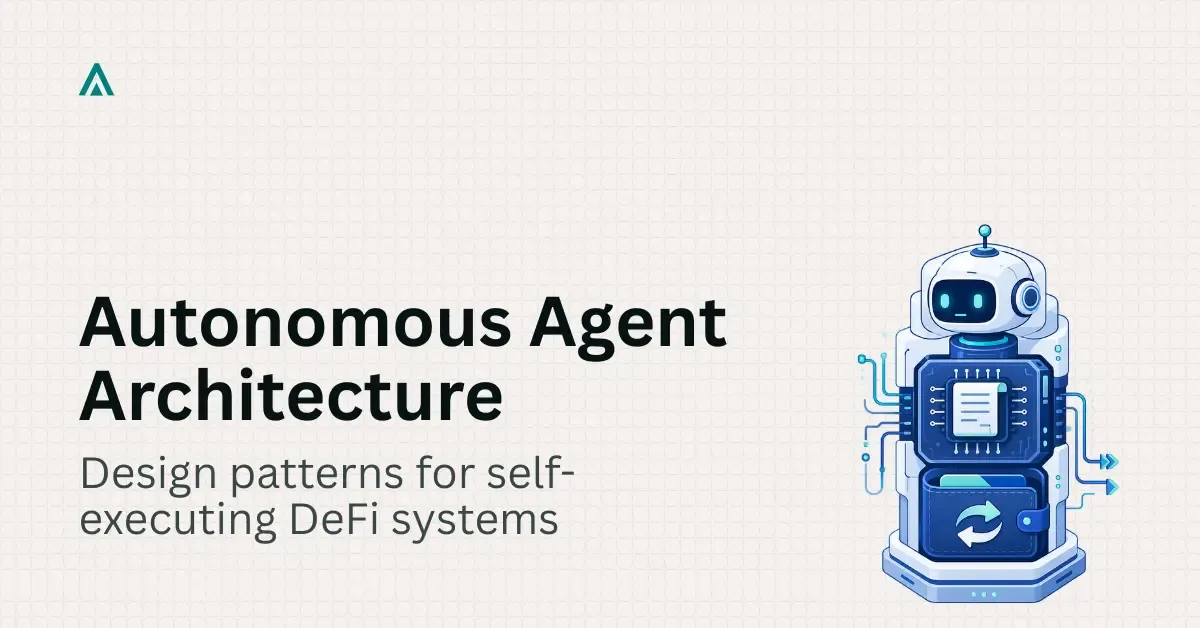
Build autonomous DeFi agents in 2024: planner-executor architecture, ERC-4337 session-key containment, and on-chain guardrails for engineers to audit.
Frequently Asked Questions
- An autonomous DeFi agent is a software system that wraps a large language model or rule engine in a planning loop, holds state across steps, and submits transactions to a DeFi protocol without a human approving each action. In January 2024 these systems are largely theoretical or experimental. The reference patterns come from AutoGPT and BabyAGI, and production deployments are limited to narrow rebalancing or arbitrage bots with strict guardrails.
- Three constraints keep them theoretical. First, language-model planners are unreliable on multi-step tasks and can loop or hallucinate sub-goals. Second, on-chain execution requires custody of a signing key, which turns any planner bug into a direct financial loss. Third, there is no settled standard for scoping an agent's permissions on-chain. Engineers building in 2024 treat agents as research with hard guardrails, not as production autonomy.
- ERC-4337 account abstraction, live on Ethereum mainnet since March 2023, lets a smart contract account define its own validation logic. For agents this enables session keys with scoped permissions, spending limits, and paymaster-sponsored gas. An agent can hold a session key that only authorises swaps under a cap, so a planner bug cannot drain the full account. This containment is the most useful agent primitive available to engineers in 2024.
Don't Miss What's Next
Subscribe to newsletter
Tags:
Autonomous Agents
DeFi
Agent Architecture
AI Agents
Get in Touch
Our team will get back to you within 24 hours.