Zero-Knowledge Proofs Explained: A Business Guide (2025)
Table of Contents
Table of Contents
Share
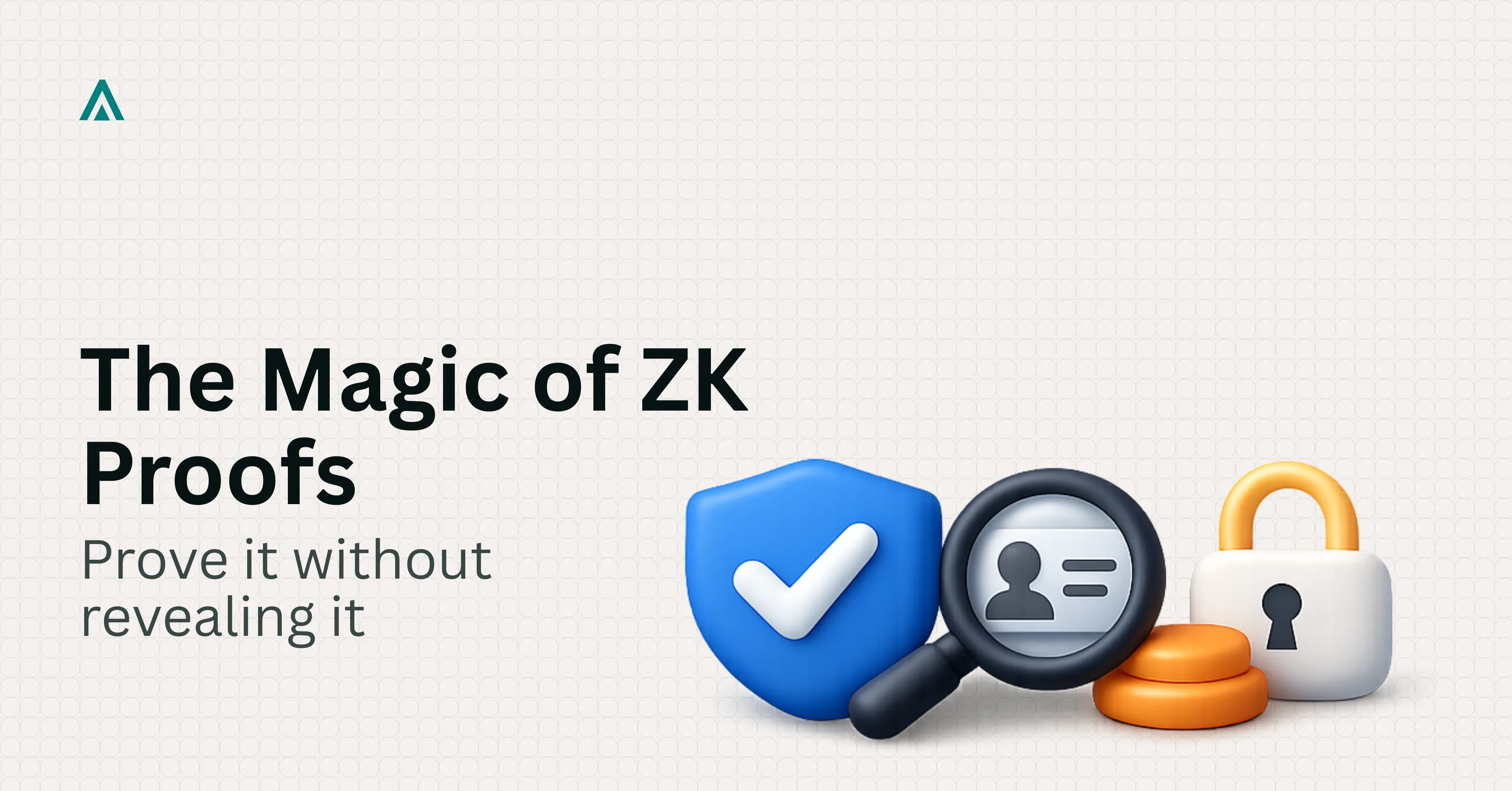
ZK proofs verify identity and compliance on-chain without exposing private data. Learn how ZKPs work, key use cases, and how to build with them in 2025.
Frequently Asked Questions
- A zero-knowledge proof is a cryptographic method that lets one party prove a statement is true to another party without sharing any data behind the claim. For example, a user can prove they are over 18 or meet an income threshold without revealing their actual birthdate or financial records. The verifier learns only that the claim is valid, nothing else.
- Encryption protects data in transit or at rest, but the data must still be decrypted and revealed to the verifying party at some point. Zero-knowledge proofs never reveal the underlying data at all. The verifier checks a mathematical proof and confirms validity without seeing any private input. This makes ZKPs fundamentally different in architecture and use case from encryption.
- The primary business use cases in 2025 are: privacy-preserving KYC and identity verification under GDPR and eIDAS 2.0 without storing sensitive data, compliant DAO voting and governance without exposing voter identity, ZK rollups that scale Ethereum transaction throughput while preserving settlement security, and private credential checks for DeFi accreditation requirements. All four use cases are in active production across Web3 protocols by late 2025, with ZK rollups accounting for the largest share of adoption by TVL.
Don't Miss What's Next
Subscribe to newsletter
Tags:
zero-knowledge proofs
zkps
zk-snarks
web3 privacy
blockchain privacy
Privacy
Get in Touch
Our team will get back to you within 24 hours.