LLaMA 2 Fine-Tuning for Smart Contract Analysis (PEFT)
Table of Contents
Table of Contents
Share
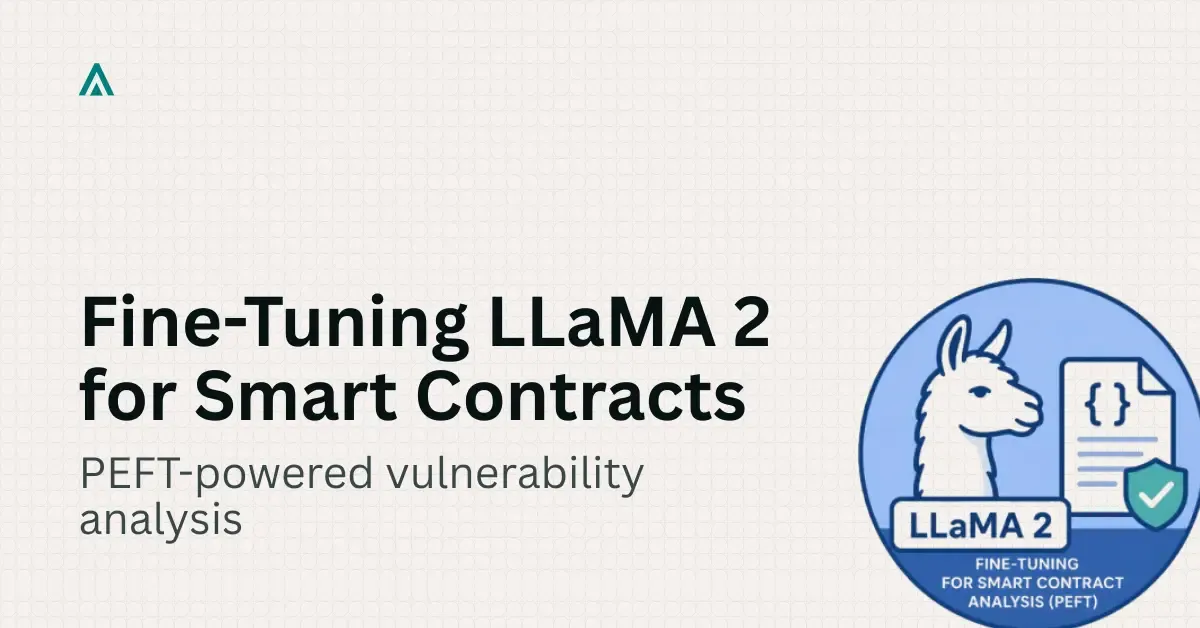
LLaMA 2 + LoRA cuts trainable parameters 10,000x vs full fine-tuning. Audit smart contract analysis pipelines with PEFT configs and Slither benchmarks.
Frequently Asked Questions
- Parameter-efficient fine-tuning, or PEFT, is a family of methods that train a small set of new parameters while freezing the base model weights. LoRA and QLoRA are the dominant variants. They matter for smart contract analysis because they reduce a multi-GPU training run into a single A100 or H100 job, putting domain-adapted LLaMA 2 deployment within reach of small audit teams and Web3 protocol developers.
- Fine-tuned LLaMA 2 is complementary to deterministic analyzers, not a replacement. Slither and Mythril detect known vulnerability classes through static analysis and symbolic execution with high precision and recall on covered patterns. A fine-tuned LLM excels at flagging novel patterns, summarizing audit findings in natural language, and triaging large codebases for human reviewer attention. The production setup uses both in sequence.
- The strongest open results combine three sources: published audit reports paired with their findings as instruction-response examples, the SmartBugs Curated dataset for labeled examples across canonical bug classes, and synthetic instruction pairs generated from verified contracts on Etherscan. Per-example formatting follows the Alpaca instruction format with explicit code-block delimiters.
Don't Miss What's Next
Subscribe to newsletter
Tags:
LLaMA 2
fine-tuning
PEFT
LoRA
smart contract analysis
2024
Smart Contracts
Get in Touch
Our team will get back to you within 24 hours.