DORA Article 19 ICT Incident Reporting: Classification
Table of Contents
Table of Contents
Share
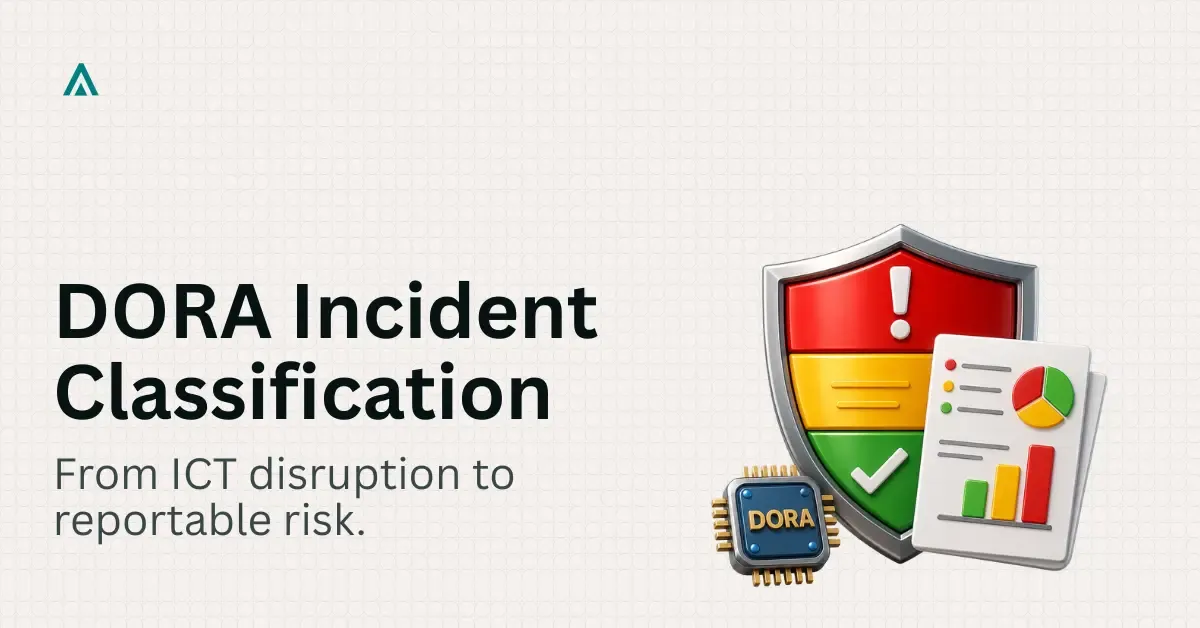
DORA Article 19 ICT incident reporting: audit classification thresholds, EBA RTS criteria, timeline tiers, and a 9-step compliance guide for EU banks in 2026.
Frequently Asked Questions
- Under DORA Article 19, an ICT incident is any unplanned event that disrupts ICT services or compromises data security. A major ICT incident meets one or more EBA RTS severity thresholds, for example a client impact exceeding one in ten clients or service unavailability exceeding 2 hours for critical systems, and triggers mandatory notification to competent authorities within 4 hours of classification.
- DORA Article 19 sets three reporting deadlines. The initial notification must reach the competent authority within 4 hours of classifying an incident as major, and no later than 24 hours after first becoming aware. An intermediate report is required within 72 hours of the initial notification. A final report must be submitted within one month of the initial notification, detailing root cause, impact scope, and remediation steps taken.
- DORA Article 19 applies to all financial entities defined in Article 2 of Regulation EU 2022/2554, including credit institutions, payment institutions, electronic money institutions, investment firms, crypto-asset service providers, central counterparties, trade repositories, and insurance undertakings operating within the EU. Micro-enterprises with fewer than 10 employees and annual turnover below EUR 2 million are exempt from certain provisions but retain baseline incident reporting obligations.
Don't Miss What's Next
Subscribe to newsletter
Tags:
DORA
ICT Incident Reporting
Article 19
EU Compliance
Financial Regulation
EBA
Operational Resilience
Web3 Compliance & Regulation
Get in Touch
Our team will get back to you within 24 hours.